Welcome to Changsha Mining Equipment Co., Ltd.
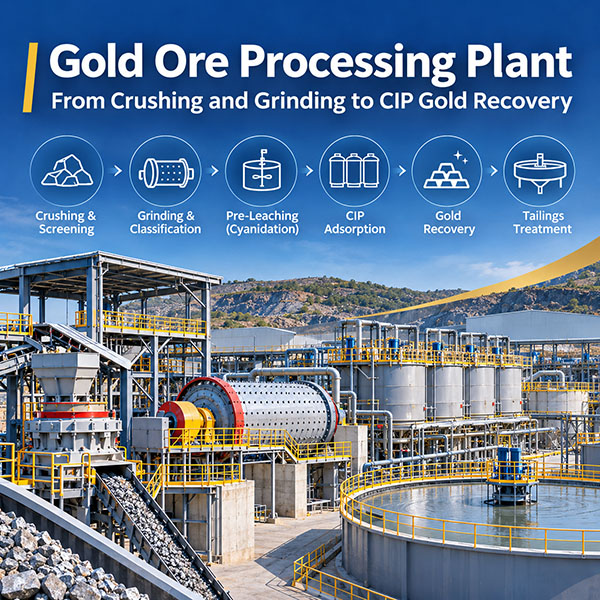
Gold Ore Processing Plant: From Crushing and Grinding to CIP Gold Recovery
Gold ore processing involves a series of interconnected operations designed to liberate gold from surrounding minerals, extract it efficiently, and manage the remaining tailings. Each stage serves a specific function, and its performance can directly influence the efficiency of subsequent operations.
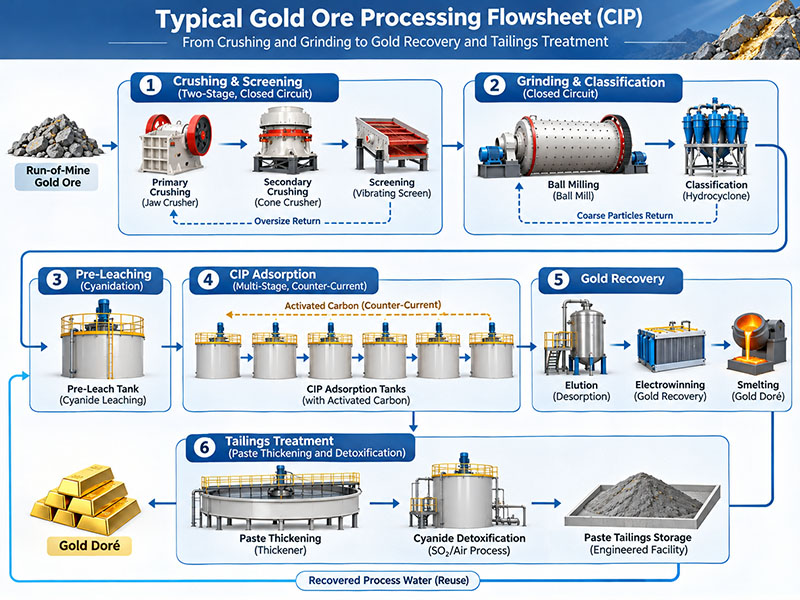
For hard-rock gold ores suitable for cyanidation, a conventional processing flowsheet may combine crushing, wet grinding, cyanide leaching, Carbon-in-Pulp (CIP) adsorption, gold recovery, and tailings treatment.
Understanding how these operations work together is essential for evaluating process efficiency, equipment requirements, and overall plant performance.
1. Crushing and Screening: Preparing Ore for Grinding
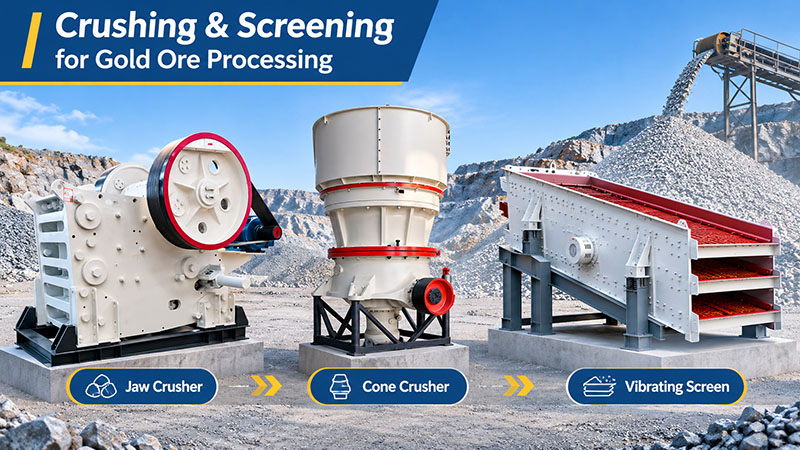
The first stage of gold ore processing is crushing, which reduces large run-of-mine rocks to a size suitable for grinding. A typical hard-rock gold processing plant may adopt a two-stage crushing circuit consisting of primary crushing, secondary crushing, and screening.
Primary Crushing
A jaw crusher is commonly used for primary crushing. Large ore particles are broken down through compressive forces between fixed and moving jaw plates. Primary crushing focuses on reducing large rocks to a manageable size for subsequent processing rather than producing finely ground material.
Secondary Crushing and Screening
Following primary crushing, the ore is further reduced by a cone crusher. A vibrating screen separates the crushed material according to particle size. Material that meets the required size specification proceeds to the grinding circuit, while oversized particles are returned to the secondary crusher.
This arrangement creates a closed circuit between secondary crushing and screening, helping control the final crushed product size and maintain consistent feeding conditions for downstream grinding. A stable crushing product is particularly important because variations in feed size can affect ball mill performance and energy consumption.
2. Closed-Circuit Grinding and Hydrocyclone Classification
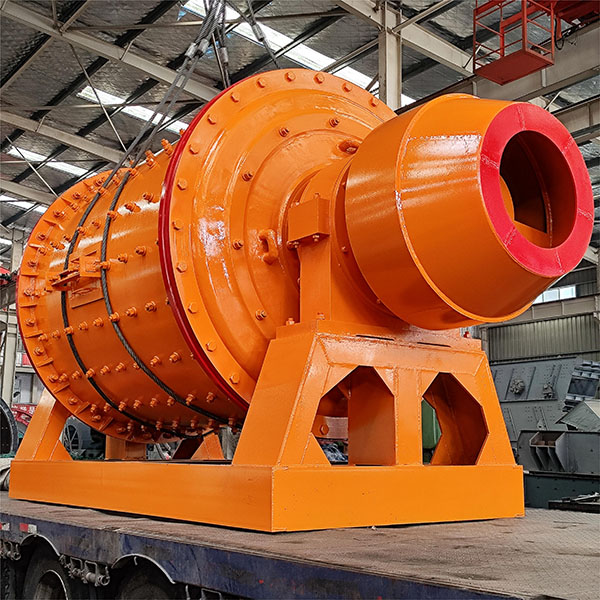
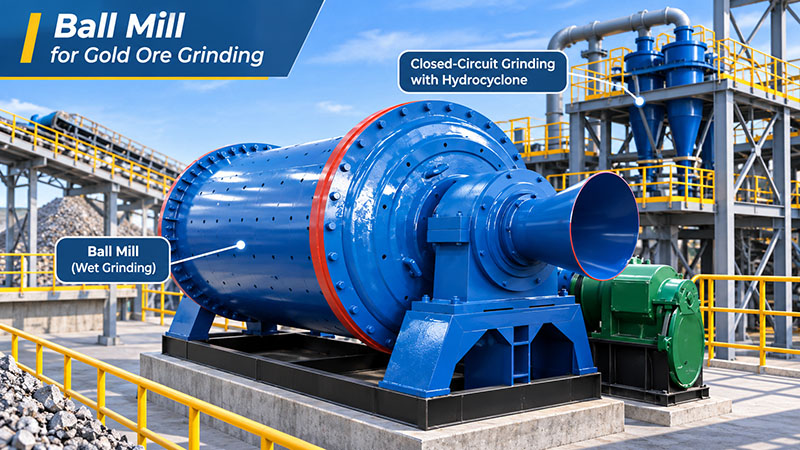
After crushing, the ore enters the grinding circuit, where further size reduction is required to expose gold-bearing minerals. In many hard-rock gold processing plants, wet ball mills operate in a closed circuit with hydrocyclones.
Inside the ball mill, ore particles are broken down through impact and abrasion as the rotating drum moves the grinding media. Water is introduced to form a slurry, allowing the ground material to be transported and classified.
Hydrocyclone Classification
The slurry discharged from the grinding circuit is classified using hydrocyclones. Coarser particles are directed back to the ball mill for further grinding, while finer particles leave the circuit and proceed to gold extraction.
This continuous circulation allows the grinding system to control product fineness while reducing unnecessary overgrinding.
Why Grinding Fineness Matters
Gold particles are often enclosed within other minerals, making sufficient liberation essential for efficient extraction. If the ore is ground too coarsely, some gold may remain inaccessible to the leaching solution. Conversely, excessively fine grinding increases energy consumption and can create difficulties in slurry handling and downstream processing.
The required grinding fineness should therefore be determined by ore mineralogy, gold liberation characteristics, and metallurgical test results.
3. Pre-Leaching and Carbon-in-Pulp (CIP) Adsorption
Once the ore has been ground to the required fineness, the slurry enters the gold extraction circuit.
For ores suitable for cyanide leaching, a process incorporating pre-leaching followed by Carbon-in-Pulp adsorption can be used.
Pre-Leaching
During pre-leaching, the ground ore slurry is contacted with a cyanide solution under controlled operating conditions. This stage aims to dissolve accessible gold into the liquid phase before the slurry enters the carbon adsorption circuit.
Effective leaching depends on factors such as mineral composition, particle size, slurry conditions, dissolved oxygen availability, and retention time. Operating parameters should be optimized based on the ore's metallurgical characteristics.
Multi-Stage CIP Adsorption
Following pre-leaching, the slurry passes through a series of adsorption tanks containing activated carbon. Activated carbon has a strong affinity for dissolved gold cyanide complexes, allowing gold to be transferred from the solution onto the carbon surface.
In a conventional CIP arrangement, slurry moves progressively through the adsorption tanks, while activated carbon is transferred in the opposite direction. This counter-current arrangement helps maintain a favorable concentration gradient between dissolved gold in the solution and gold adsorbed on the carbon, sustaining the mass-transfer driving force for adsorption throughout the circuit.
Interstage screens retain the carbon within the adsorption system while allowing slurry to move between tanks. As adsorption continues, gold accumulates on the activated carbon until the loaded carbon is removed for subsequent recovery.
4. Gold Recovery: Elution, Electrowinning, and Smelting
After the activated carbon has adsorbed sufficient gold, it is separated from the adsorption circuit and transferred to the gold recovery section. The recovery process generally involves elution, electrowinning, and smelting.
Elution
During elution, gold is desorbed from the loaded activated carbon into a concentrated solution under controlled conditions. This transfers the adsorbed gold from the carbon into a liquid stream suitable for further recovery.
Electrowinning
The gold-bearing eluate is then treated by electrowinning, in which an electrical current is used to recover gold from the solution onto cathode surfaces. The recovered material is collected for further treatment.
Smelting and Carbon Regeneration
The gold-bearing product from electrowinning undergoes preparation and smelting to produce gold doré. Meanwhile, stripped activated carbon can be regenerated to restore its adsorption properties before being returned to the CIP circuit. Carbon regeneration and reuse help maintain adsorption performance and reduce the consumption of fresh activated carbon.
5. Tailings Thickening and Cyanide Detoxification
After gold extraction, the remaining slurry contains finely ground solids, process water, and residual chemicals. Proper tailings treatment is essential for water recovery, waste management, and environmental protection.
Tailings Paste Thickening
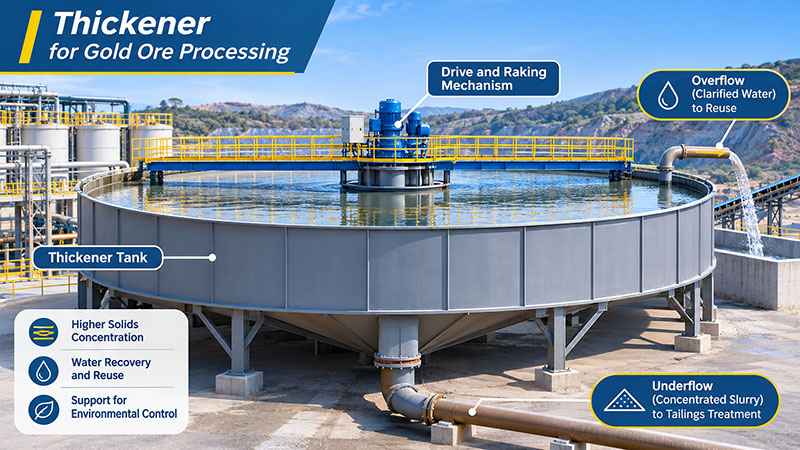
A paste thickener can be used to increase the solids concentration of the tailings slurry. Inside the thickener, suspended particles settle under gravity, often assisted by flocculants that promote particle aggregation. As solids accumulate near the bottom, a concentrated underflow is produced, while clarified liquid is collected from the upper section.
Compared with conventional dilute tailings slurry, thickened paste has a higher solids concentration and may exhibit different flow and deposition characteristics. The recovered overflow water may be suitable for reuse in the processing plant, subject to water-quality requirements and appropriate treatment.
Cyanide Detoxification Using the SO₂/Air Process
Because cyanide is used during gold leaching, residual cyanide in the tailings must be managed before final disposal. The sulfur dioxide/air process is a commonly used chemical treatment method for cyanide destruction.
In this process, sulfur dioxide or a suitable sulfite source, together with air and a catalyst, promotes the oxidation of cyanide to the substantially less toxic cyanate. Appropriate chemical conditions and process controls are necessary to achieve the required treatment performance.
The placement of cyanide detoxification relative to thickening depends on the specific plant design, tailings characteristics, and environmental requirements.
Paste Tailings Storage
Following the required thickening and detoxification operations, treated tailings may be transferred to an engineered paste storage facility. Paste tailings systems can reduce the volume of free water associated with tailings deposition and support more controlled storage arrangements.
However, thickening alone does not eliminate environmental risks. Proper containment, drainage, water management, and long-term monitoring remain essential.
6. How the Processing Stages Work Together
Although crushing, grinding, leaching, adsorption, and tailings treatment are separate operations, they form an integrated processing system.
Crushing prepares the ore for efficient grinding. Grinding increases the exposure of gold-bearing minerals, enabling more effective cyanide leaching. The CIP circuit then captures dissolved gold onto activated carbon for recovery through elution, electrowinning, and smelting.
Meanwhile, tailings thickening and cyanide detoxification manage the remaining process streams and support responsible water and waste management.
Overall process efficiency depends not only on individual equipment performance but also on maintaining stable operating conditions and suitable material characteristics between stages. A gold processing flowsheet should therefore be developed based on ore characterization, metallurgical testing, water balance considerations, and site-specific engineering requirements.
Conclusion
A conventional CIP gold processing plant relies on the coordinated operation of several important stages, beginning with ore crushing and grinding and continuing through cyanide leaching, carbon adsorption, gold recovery, and tailings management.
Each stage serves a distinct function, but all contribute to the same objective: achieving effective gold recovery while maintaining stable processing conditions and appropriate environmental controls. Understanding the function and interaction of these processes provides a practical foundation for evaluating gold processing plant designs and selecting suitable mineral processing equipment.
For further technical information on equipment commonly used in these operations, see the Crushing and Grinding Equipment and Thickener Equipmentcategories.
Note: This article describes a generalized gold processing flowsheet for educational purposes. Actual process configurations and operating conditions vary according to ore properties, metallurgical test results, and project-specific requirements.
Sabrina He | Mining Machinery Specialist
With over 14 years of experience in the mining equipment industry, Sabrina He specializes in machinery selection, technical troubleshooting, and plant optimization.