Welcome to Changsha Mining Equipment Co., Ltd.
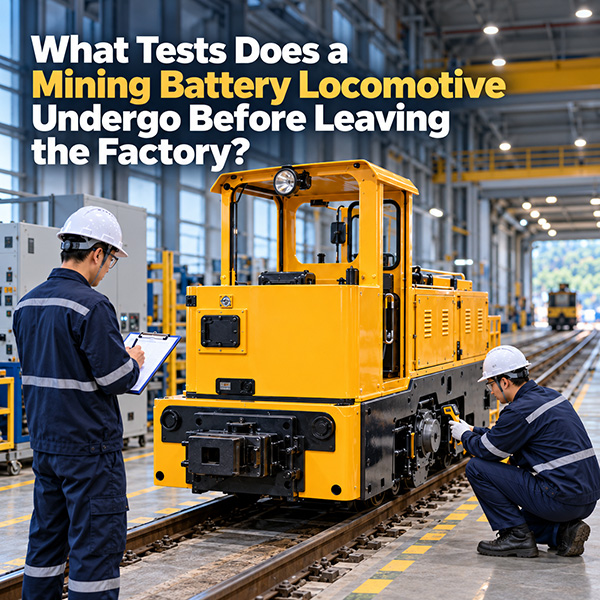
What Tests Does a Mining Battery Locomotive Undergo Before Leaving the Factory?
Before a mining battery locomotive leaves our factory, it must pass a series of factory inspections and running tests.
For underground mining equipment, completing assembly is not the last step of production. The electrical system, transmission system, pneumatic system, explosion-proof electrical components, and complete locomotive operation all need to be checked before shipment.
For our explosion-proof battery locomotives, the factory inspection is carried out according to the applicable technical requirements. The inspection report records each test item, technical requirement, measured result, and inspection result.
Below are some of the main inspection items carried out before delivery.
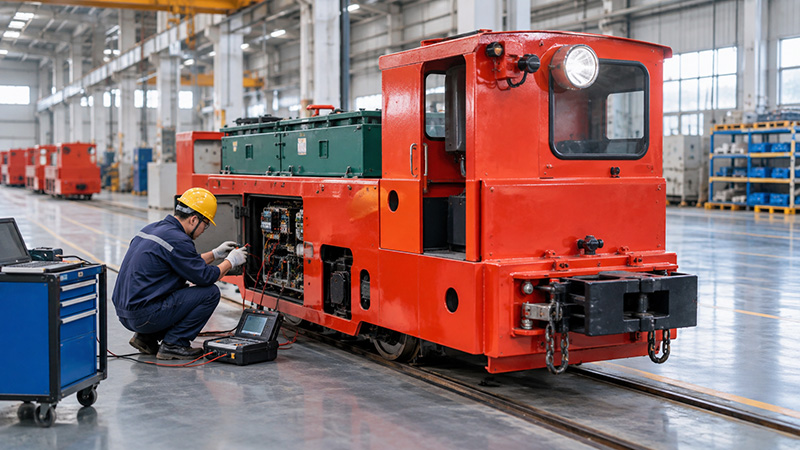
1. Electrical Insulation Resistance Test
The insulation performance of the locomotive electrical circuit is checked before shipment.
According to the inspection requirement, the insulation resistance between the electrical circuit and ground should be not less than 0.5 MΩ.
The electrical system of a battery locomotive includes motors, controllers, cables, connectors, and other electrical components. After these components are installed and connected, insulation resistance testing is carried out on the complete locomotive electrical system.
The measured value is recorded in the factory inspection report.
This test helps us confirm the insulation condition of the electrical circuit before the locomotive is delivered to the customer.
2. Dielectric Withstand Voltage Test
The locomotive electrical circuit also undergoes a dielectric withstand voltage test.
During this test, the specified test voltage is applied to the circuit for one minute. There should be no breakdown or flashover during the test.
This inspection is carried out after the relevant electrical components have been installed on the locomotive.
Compared with checking individual electrical components separately, testing the assembled electrical system can help verify the condition of the complete circuit before shipment.
The test voltage, test duration, and result are recorded as part of the factory inspection.
3. Bearing Temperature Test
During the running test, the temperature of the rolling bearings is also checked.
According to the inspection requirement, when the ambient temperature is 40°C, the rolling bearing temperature should not exceed 95°C, and the temperature rise should be 55 K or less.
During inspection, technicians record the ambient temperature, final bearing temperature, and temperature rise.
Bearing temperature is an important operating parameter for the locomotive transmission system. Abnormal temperature rise may indicate a problem with installation, lubrication, alignment, or mechanical resistance.
For this reason, the bearing condition is checked under actual running conditions instead of only being inspected visually after assembly.
4. Reduction Gear No-Load Running Test
The reduction gear is one of the main parts of the locomotive transmission system.
Before delivery, a no-load running test is carried out at maximum rotational speed.
The reduction gear runs:
30 minutes in the forward direction and 30 minutes in the reverse direction.
During this test, our technicians check several items.
All connections and fasteners should remain properly secured without loosening.
The rotating surfaces and joint surfaces of the reduction gear are checked for oil leakage.
The reduction gear should operate smoothly without impact, abnormal vibration, or abnormal noise.
The inspection requirement also specifies that the maximum noise level of the reduction gear should not exceed 85 dB.
Running the reduction gear continuously in both directions gives our inspection team enough time to observe its operating condition after assembly.
If abnormal noise, leakage, vibration, or loose components are found during the test, they can be checked and corrected before the locomotive is approved for delivery.
5. Pneumatic System Air-Tightness Test
For locomotives equipped with a pneumatic system, the air tightness of the system is also inspected.
The system is first charged to its working pressure. With the air valves in the specified position, the pipeline pressure is monitored for a defined period.
According to the factory inspection requirement, after 16.5 minutes, the pressure drop in the pipeline should not exceed 0.01 MPa.
The pneumatic system contains pipelines, valves, joints, and other connections. Therefore, reaching the required pressure alone is not enough.
The system also needs to maintain pressure within the specified limit.
This test is used to check whether there is abnormal air leakage in the pneumatic pipelines and connections before shipment.
6. Inspection of Explosion-Proof Electrical Components
For an explosion-proof battery locomotive, the electrical components used on the locomotive are also included in the factory inspection.
The inspection covers the relevant:
· Product certificates
· Safety markings
· Explosion-proof markings
These items are checked as part of the complete locomotive inspection.
For underground mining projects, buyers often need to check not only the locomotive specifications but also the identification and documentation of the electrical components installed on the machine.
Therefore, this inspection is included before the locomotive is released for shipment.
7. Factory Track Running Test
After the electrical and mechanical inspections are completed, the locomotive is tested on our factory track.
The locomotive runs on the corresponding rail gauge and passes through straight sections and specified curves.
During the track test, our technicians check the running condition of the complete locomotive.
The inspection includes checking whether the locomotive runs normally on the track, whether there is any rail climbing, whether the track has permanent deformation, and whether the connection between the locomotive and mine cars remains reliable.
This test is important because the locomotive is inspected as a complete machine under actual running conditions.
The traction motor, transmission system, wheelsets, electrical control system, and mechanical structure all work together during the track test.
It allows our technicians to check issues that may not be visible during individual component inspections.
The video above shows a mining locomotive running on the test track at our factory before shipment.
Factory Inspection Before Shipment
Our factory inspection is not limited to checking whether the locomotive can start and move.
Before delivery, different systems of the locomotive are inspected separately, followed by a complete track running test.
Depending on the locomotive configuration, the inspection process includes:
· Electrical insulation resistance testing
· Dielectric withstand voltage testing
· Bearing temperature inspection
· Reduction gear forward and reverse running tests
· Reduction gear noise and leakage inspection
· Pneumatic system air-tightness testing
· Explosion-proof electrical component verification
· Complete locomotive track running test
The purpose of these inspections is straightforward: problems should be identified and handled at the factory before the equipment is shipped to the mine site.
The inspection results are recorded in the factory inspection report and reviewed before the locomotive is approved for delivery.
For customers purchasing mining locomotives from overseas suppliers, the factory inspection process is also an important part of supplier evaluation.
Product specifications show what a locomotive is designed to do. Factory testing shows how the finished locomotive is checked before it reaches the customer.
Looking for a Battery Locomotive for Your Mining Project?
We manufacture battery locomotives for underground mining and tunneling applications.
To recommend a suitable locomotive, we normally need information such as:
· Required locomotive tonnage
· Rail gauge
· Required hauling capacity
· Mine roadway conditions
· Operating gradient
· Working environment
· Required electrical and control configuration
If you are planning a new project or replacing existing mining locomotives, send us your operating requirements. We can provide a locomotive configuration based on your actual working conditions.
Aizen Liu | Delivery Manager
I oversees our international supply chain, ensuring that heavy-duty mining equipment reaches your site safely and on schedule. From complex customs clearance to final delivery, I provides a seamless and hassle-free procurement experience for our global clients.