Welcome to Changsha Mining Equipment Co., Ltd.
Inside the Powerhouse: How the Two-Stage Gearbox Drives Our 5-Ton Mining Electric Locomotive
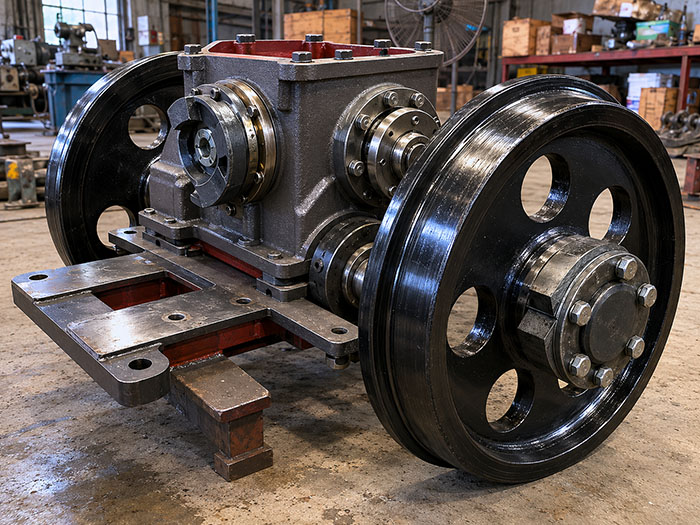
If you follow us on social media, you may have seen the short video that recently sparked a wave of interest among mining professionals. The clip captures the assembly process of a 5-ton mining electric locomotive inside our workshop — gears meshing, bearings seating, and a brand-new wheelset taking shape. The most commented moment comes when the camera zooms in on the gearbox internals, showing precisely how power is channeled from the traction motor to the wheels.
The question many viewers asked is simple yet crucial: in a harsh underground mining environment, where a 5-ton locomotive must pull ore cars several times its own weight, where does that immense tractive effort actually come from? The answer lies in a single, heavily engineered assembly mounted directly on the wheelset — the two-stage reduction gearbox.
The Anatomy of the 5-Ton Locomotive Gearbox
Open the shop drawing or watch the first few frames of our video, and you will immediately notice how compactly the gearbox is suspended on the locomotive axle. This is not an isolated transmission unit linked by a long drive shaft; it is an axle-hung structure. The entire gearbox housing wraps around the axle and is supported by it, which means the output gear directly drives the wheelset without intermediate couplings. From an engineering buyer’s perspective, this layout eliminates alignment losses and ensures that every watt of electric power reaches the wheel tread with maximum efficiency.
At the heart of the design sits a key number: the total reduction ratio of *i* = 15.78. This is not a rounded, generic figure — it is the exact product of two carefully matched gear stages. For the mine operator, 15.78 means the high-speed rotation of a standard traction motor (often around 1,200 to 1,500 rpm) is converted into low-speed, ultra-high-torque output.
The result is an electric locomotive that can start a fully loaded train from a dead stop on a grade, crawl steadily through uneven track, and resist stalling even when track conditions are less than ideal. High torque at the wheelset rim translates directly into operational reliability, and that is what keeps production targets on track.
Deep Dive: How the Two-Stage Reduction Works
Let’s go further inside the gearbox — here the video’s second half becomes especially instructive, because you can see the meshing of two completely different gear types. The transmission logic follows two distinct stages, and every tooth profile serves a specific purpose.
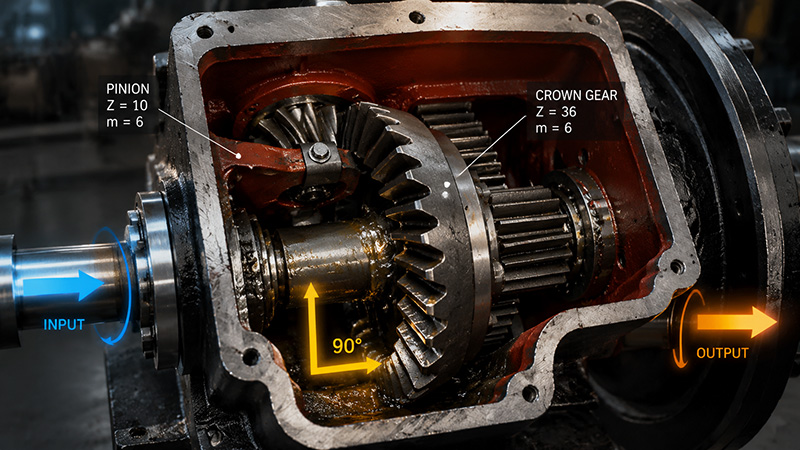
Stage 1: The First Reduction & Direction Change
The traction motor delivers power along an axis that is longitudinal to the locomotive frame. To drive the wheels, this power must be turned 90 degrees so that it aligns with the axle. The solution is a precision-ground bevel gear set. The input pinion is a small bevel gear with tooth count Z = 10 and module *m* = 6; it engages a large bevel gear with Z = 36 and the same module. This pair accomplishes two things simultaneously: it converts the rotation from a longitudinal to a transverse plane, and it provides an initial speed reduction of 36/10 = 3.6. The large module of 6 is a critical specification here.
In mining duty, shock loads are the norm — track joints, switches, and occasional wheel slip all send harsh impact spikes back through the drivetrain. A module-6 bevel gear set has substantially thicker, stronger teeth than lighter industrial alternatives, giving it the capacity to absorb those shocks without fracture.
Stage 2: The Second Reduction & Heavy Torque Multiplication
Once rotation is aligned with the axle, the intermediate shaft carries a small spur gear — Z = 13, *m* = 5 — that meshes with a large spur gear mounted directly on the wheelset axle. The large spur gear has Z = 57 teeth and the same module 5. This second reduction stage yields a ratio of 57/13 ≈ 4.38.
Here the power flow is simple: the intermediate gear drives the axle gear, and because the axle gear is significantly larger, speed drops further while torque multiplies dramatically. The choice of spur gears for the final stage is deliberate. Spur gears handle radial loads efficiently and are easier to machine to high precision, which is essential when the gear must fit perfectly on the axle inside a sealed housing. The module of 5 again indicates robustness — these are not lightweight automotive gears, but mining-class components built to survive years of continuous operation.
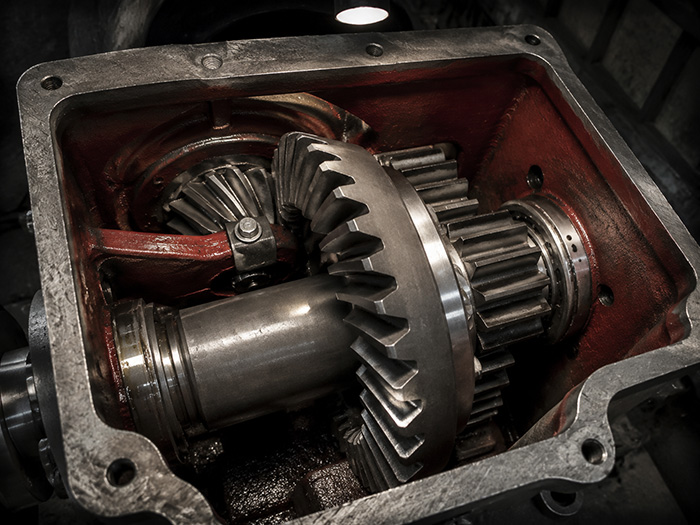
There is a satisfying mathematical check that validates the entire design. Multiply the first-stage ratio by the second-stage ratio: 3.6 × (57/13) = 3.6 × 4.3846 ≈ 15.78. The number matches exactly the total reduction ratio embossed on the gearbox specification plate. For any mining engineer or maintenance superintendent, this kind of transparency is reassuring. It confirms that the gearbox is not a black box, but a system whose performance can be calculated, inspected, and trusted.
In many mining conversations, there is a subtle debate: bevel gear vs spur gear in mining transmissions. The answer is not either-or. Our gearbox demonstrates that the optimal solution is a combination — bevel gears where you need to change power direction, spur gears where you need maximum torque transmission directly onto the axle. Each type is deployed exactly where its mechanical advantages outweigh its limitations.
Why This Design Matters for Your Mining Operations
As a mining equipment supplier, we translate engineering specifications into benefits that directly affect a mine’s bottom line. Here is what the two-stage gearbox means for your fleet:
Heavy Load Capability. Underground track is never perfect. Sudden braking, debris on the rails, and heavy starting pulls generate intense shock loads that can strip teeth off inadequately designed gears. The large module sizes (*m* = 5 and 6) and the combined bevel-and-spur architecture spread these loads over wider tooth contact areas. The result is a gearbox that keeps turning even when the going gets rough.
Compact and Dust-Proof. Space in a 5-ton mining locomotive is extremely tight — narrow-gauge track limits every dimension. The integrated axle-hung gearbox eliminates the need for separate transmission housings and long shafts, saving weight and volume. Additionally, the fully enclosed cast housing provides a complete barrier against the coal dust, rock fines, and acidic mine water that cause open-gear systems to fail prematurely. In many underground mines, dust ingress is the number one cause of premature gear wear; our sealed design addresses that head-on.
Low Maintenance Cost. A gearbox that requires frequent inspection or parts replacement directly erodes mine productivity. Thicker gear teeth wear more slowly, and the two-stage layout distributes stress evenly rather than concentrating it on a single gear pair. Operators report significantly longer intervals between oil changes and gear inspections compared with lighter-duty alternatives. Reduced downtime means more tonnes moved per shift, and that remains the ultimate measure of a mining locomotive’s value.
Conclusion
The two-stage reduction gearbox is not just a component — it is the engineering core that defines the reliability of our 5-ton mining electric locomotive. From the mathematical precision of the 15.78 total ratio to the robust module selections, every detail is designed to deliver dependable tractive power in the toughest underground conditions.
If you would like to watch the full gear-motion video and see the wheelset assembly in action, follow us on our social media channels or leave a comment below. And if you are currently evaluating options for your mine and need a heavy-duty, cost-effective 5-ton locomotive that won’t let you down, click here to speak with our sales team. We will provide a complete quotation package along with a detailed technical white paper that goes even deeper into the gearbox’s performance data.
Sabrina He | Mining Machinery Specialist
With over 14 years of experience in the mining equipment industry, Sabrina He specializes in machinery selection, technical troubleshooting, and plant optimization.