Welcome to Changsha Mining Equipment Co., Ltd.
The Ultimate Guide to Forged Ball Chemical Composition: Beyond Surface Hardness
In the demanding world of mineral processing, the true cost of your grinding media isn’t measured merely by its price per ton, but by its performance in the mill. A common and costly pitfall is selecting forged steel balls based solely on surface hardness (HRC).
The real key to minimizing your operational expenditure lies much deeper—in the precise chemical matrix of the steel. This guide dissects the metallurgical DNA of standard grades like 65Mn, the premium B-series (B-2, B-3, B-4, B-6), and high-carbon GCr15, revealing how their chemistry dictates your mill throughput and cost per ton of ore ground.
How Chemical Elements Dictate Grinding Performance
For a mill engineer or procurement manager, a material specification sheet can seem like an alphabet soup of elements. However, each element is a carefully tuned ingredient that defines the life and death of a grinding ball.
Carbon (C): The Hardness Backbone
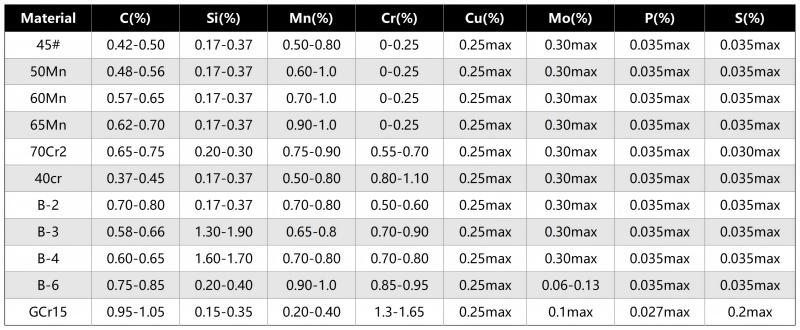
Carbon is the primary element that determines a steel’s achievable hardness. During heat treatment, carbon allows the formation of martensite—a hard, needle-like microstructure. As seen in our specifications, carbon ranges from a tough 0.37% in 40Cr to a wear-resistant 1.05% in GCr15. Higher carbon directly translates to higher hardness, but it’s a delicate balance; too much carbon without the right alloying support can induce brittleness.Manganese (Mn): The Volumetric Hardness Champion
Manganese is a critical player in ensuring the ball wears uniformly, not just on the surface. It dramatically increases the steel’s hardenability—its ability to be hardened deeply. A high manganese content, like the 0.90-1.0% in 65Mn and B-6, suppresses the transformation temperature during quenching, ensuring a consistent, deep martensitic structure from the surface to the core. This volumetric hardness is your best defense against spalling and rapid wear.Chromium (Cr): The Wear & Corrosion Shield
Chromium is a powerful carbide former. These hard chromium carbides are dispersed throughout the steel matrix, acting as microscopic barriers against abrasive ore particles. For wet grinding circuits, Chromium also provides a vital defense against corrosive slurry environments, significantly extending the ball’s service life. Notice the distinct jump from a nominal 0-0.25% in 65Mn to 1.30-1.65% in GCr15—this reflects a total shift in application philosophy.Silicon (Si): The Matrix Strengthener
Silicon’s primary role is as a deoxidizer during steelmaking, but it also acts as a potent solid-solution strengthener. By dissolving into the iron matrix, it reinforces the steel’s structure. The premium B-3 (1.30-1.90% Si) and B-4 (1.60-1.70% Si) grades are prime examples, where a high silicon content helps maintain hardness and strength even under the high-temperature friction generated within a working mill.Phosphorus (P) & Sulfur (S): The Impurity Enemies
These two elements are kept under strict control. Our parameter sheet mandates ultra-low thresholds—typically a maximum of 0.035%, with a tighter 0.027% max for P on GCr15. This discipline is non-negotiable. Exceeding these limits introduces brittleness and micro-cracking, leading to premature ball breakage that can damage mill liners and downstream equipment.
Material Grade Deep Dive: Matching Chemistry to the Challenge
65Mn: The High-Toughness Workhorse
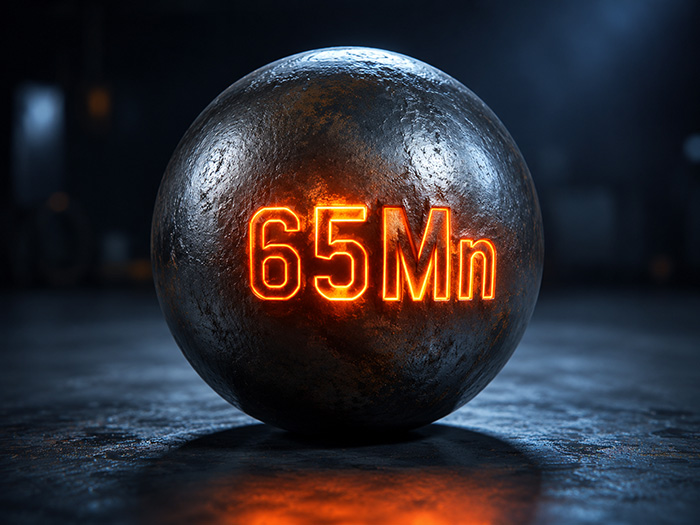
The industry’s reliable standard for a reason. Its chemistry (C: 0.62-0.70%, Mn: 0.90-1.0%) provides a superb manganese-to-carbon ratio, delivering exceptional impact fatigue resistance. This is the ball you need when structural integrity is paramount—in large-diameter SAG mills and high-drop-impact applications where a shattered ball is far more dangerous and costly than a worn one.
The Premium B-Series: Engineered Micro-Alloying
This is a family of tailored solutions, each designed to optimize a specific cost-performance metric.
B-2 (Balanced Wear): With C: 0.70-0.80% and Cr: 0.50-0.60%, B-2 provides a significant step up in abrasive wear resistance from 65Mn, making it a versatile choice for medium-sized ball mills.
B-3 & B-4 (High-Silicon Durability): These grades are defined by a massive silicon increase (up to 1.90%). This isn’t just a metallurgical tweak; it’s a solution for mills where surface softening due to high-temperature friction compromises the ball’s hardness, ensuring the cutting edge is retained for longer.
B-6 (The Multi-Alloy Specialist): The most complete formula in the B-series (C: 0.75-0.85%, Mn: 0.90-1.0%, Cr: 0.85-0.95%, and critically, Mo: 0.06-0.13%). The addition of Molybdenum refines the grain structure, creating an ultra-homogeneous, tough, and wear-resistant matrix designed for the most punishing high-stress grinding environments.
GCr15: The Ultra-High Carbon Chrome Specialist
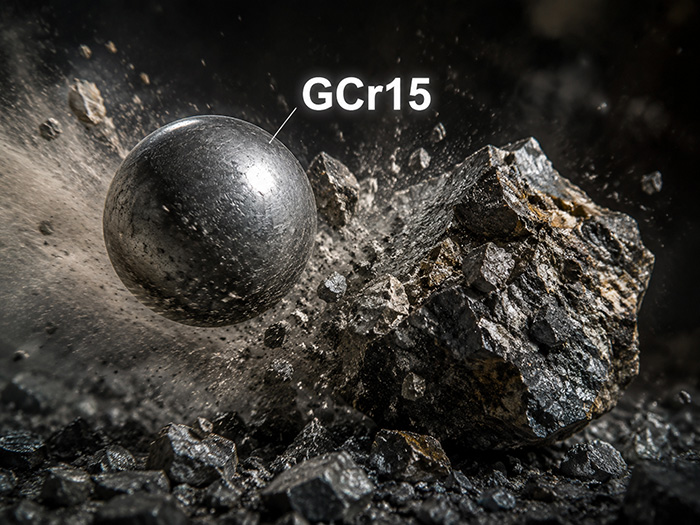
This is a bearing-quality steel engineered for extreme wear. The aggressive combination of C: 0.95-1.05% and Cr: 1.30-1.65% forms a dense population of ultra-hard carbides within a tempered martensite matrix. GCr15 achieves the highest pure abrasive wear index and is exclusively suited for fine and ultra-fine regrind circuits. Here, the impact is low, but the wear mechanism is relentless, and this high-carbon chrome specialist is the definitive answer.
Application Mapping: From Chemistry to Mill Type
How do you translate these profiles to your specific operation? Use this logic matrix:
High Impact / SAG Mills / Large Diameters (100mm-130mm):
Your primary failure risk is splitting. Prioritize High Mn & Moderate C. Select 65Mn or B-2 for their unrivaled toughness and impact resistance.Aggressive Abrasion / Corrosive Slurry / Regrind Mills:
Wear, not breakage, is your cost driver. Prioritize High Cr & High C. Select GCr15 or B-6 to maximize the service life against abrasive and corrosive slurry wear.High-Temperature Dry Grinding:
Surface softening compromises hardness. Prioritize High Si. Select B-3 or B-4 to maintain core strength and surface hardness under elevated temperatures.
Beyond Chemistry: The Manufacturing Multiplier
While chemical composition is the foundation, it is not the finished product. The most sophisticated alloy formula will fail if manufacturing is deficient. True performance is unlocked through:
Advanced Forging Technology: Automated roll-forging ensures a defect-free internal structure with a superior as-forged grain flow, eliminating the cast defects and central porosity found in cast balls.
Precision Multi-Stage Heat Treatment: A meticulously controlled quench and temper process is essential to fully transform the chosen chemistry into a uniform, fine-grained martensitic structure, delivering the designed hardness and toughness.
Conclusion & Next Steps
Selecting the optimal forged steel ball is a strategic decision that marries your mill’s kinetic energy with the perfect chemical profile—from the sheer toughness of 65Mn to the customized balance of the B-series, and the uncompromising hardness of GCr15. This chemical insight is your competitive advantage for lowering grinding costs per ton.
Unsure which alloy matrix fits your mine's specific ore hardness and mill dimensions? Contact our metallurgical engineering team today for a comprehensive grinding media consultation and a customized quotation.
Sabrina He | Mining Machinery Specialist
With over 14 years of experience in the mining equipment industry, Sabrina He specializes in machinery selection, technical troubleshooting, and plant optimization.