Welcome to Changsha Mining Equipment Co., Ltd.
How to Select the Right 2JP(B) Scraper Winch for Your Mine
A practical guide to matching specifications with real-world underground conditions
If you've ever stared at a scraper winch specification table and wondered which model actually belongs in your drift, you're not alone. The numbers all look plausible. The question is: what do they mean for your operation?
The 2JP(B) series covers a lot of ground—from the 7.5 kW unit that weighs less than 400 kg to the 110 kW behemoth that tips the scales at over 5 tonnes. But bigger isn't always better underground. Space is tight, power is finite, and the wrong choice creates headaches that last for years.
This guide walks through the selection process the way you'd actually think about it: starting with your mine's constraints, then working through the data to find the right fit.
Step 1: Know Your Constraints Before You Touch the Spec Sheet
Before looking at any numbers, get clear on three things. Write them down. They're your filters.
The distance problem. How far does the material need to move? If your drawpoint sits 50 metres from the ore pass, that's one problem. If it's 150 metres, that's a completely different problem. The winch's rope capacity needs to cover your distance plus a safety margin—otherwise you're repositioning the winch constantly, which kills productivity.
The space problem. What fits in your drift or cubby? Some of these units are nearly 2.6 metres long and 1.5 metres wide. If your working area is tight, that eliminates half the range before you even consider performance.
The power problem. What can your underground supply actually deliver? A 110 kW motor is meaningless if your distribution board trips every time it starts.
Get those three answers locked in. Everything else flows from them.
Step 2: Match Rope Capacity to Your Actual Haul Distance
The rope capacity figures tell you how far the winch can reach in one setup. For the working drum, that's the distance you can pull a loaded bucket before the rope runs out.
Here's what the numbers look like across the range:
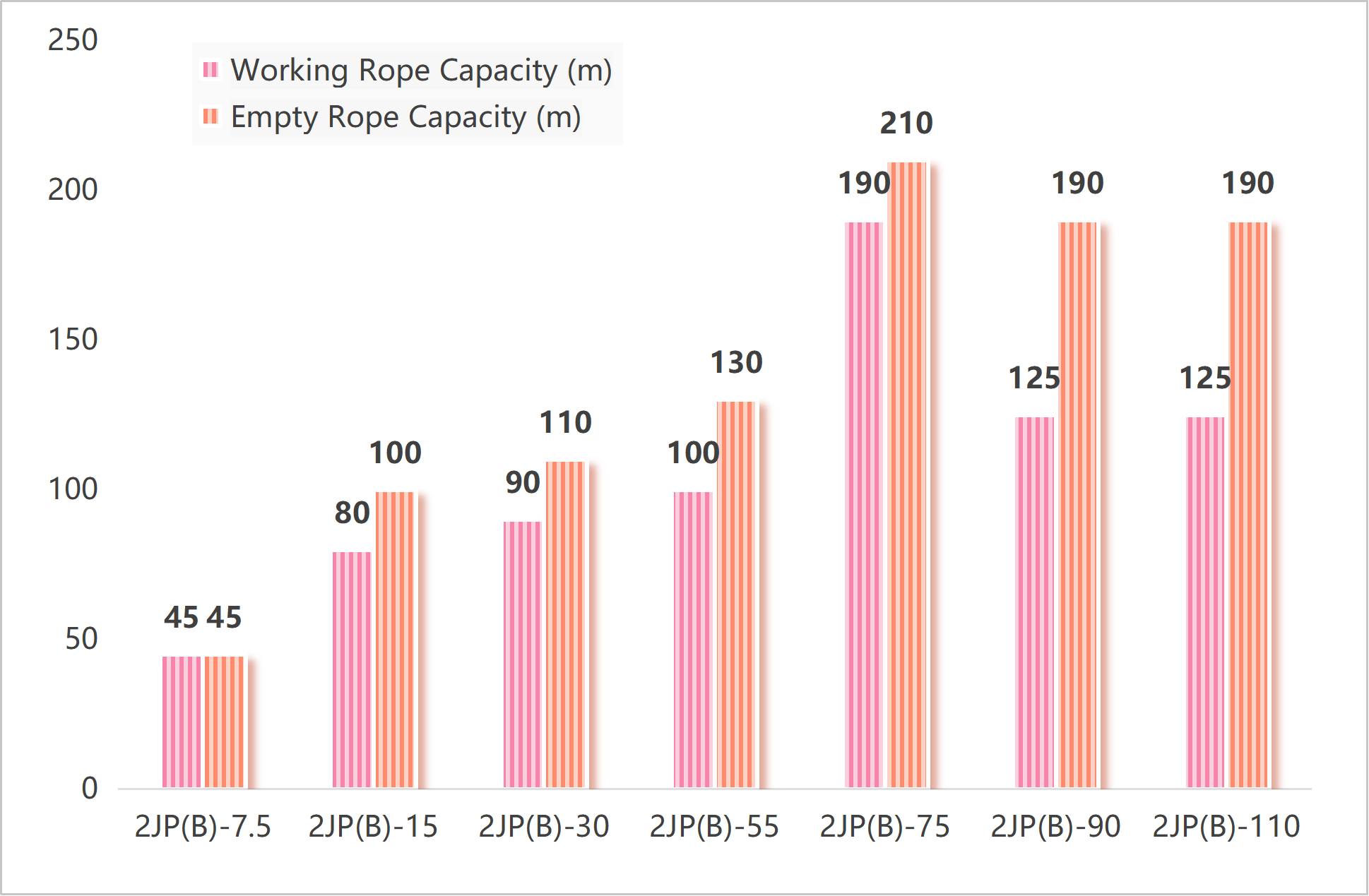
The practical rule: Your total haul distance should be no more than 80% of the working rope capacity. That leaves room for rope stretch, wear, and the fact that you don't want to spool right to the end of the drum.
So if your drawpoint is 60 metres from the ore pass, the 2JP(B)-7.5 (45 m capacity) won't work—you'd need to stop halfway. The 2JP(B)-15 (80 m) covers it comfortably. If you're looking at 160 metres, you need at least the 2JP(B)-75 (190 m) or you'll be moving the winch every few shifts.
What about the empty rope capacity? It matters less for reach and more for speed. The bigger gap between working and empty rope capacities (notice how the 2JP(B)-75 has 190 m working and 210 m empty) lets you stage the return rope longer, which can improve cycle times in certain layouts.
Step 3: Match Pulling Force to What You're Actually Dragging
This is where the table gets real. The average pulling force tells you whether the winch can actually move the load.
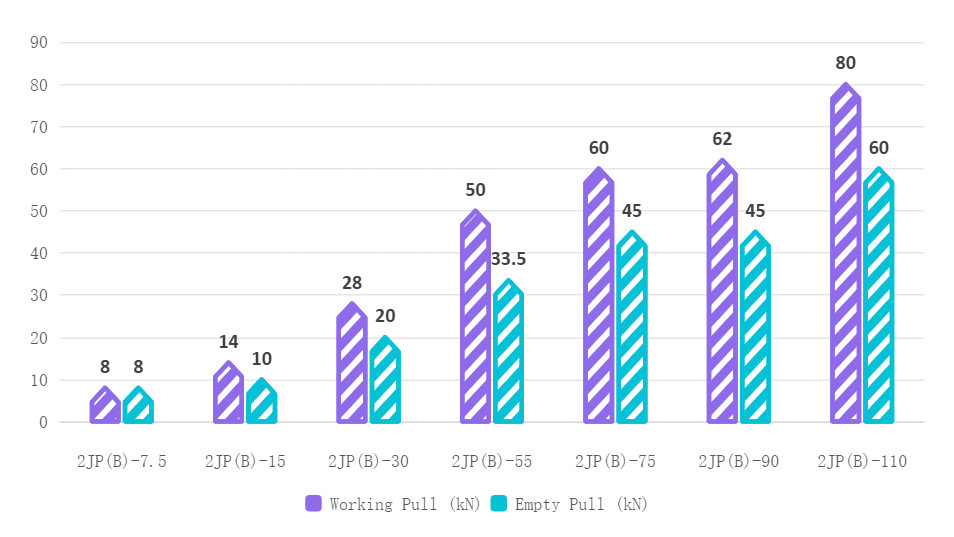
The working pull is the one that matters most. That's what drags the loaded bucket across the floor. The empty pull only needs enough force to pull an empty bucket back out, which is why it's lower on every model.
What affects required pulling force? Three things:
Slope. If your ground is level, you only need to overcome friction. But if you're scraping on a grade, gravity adds real resistance. For slopes up to about 30 degrees, you need roughly 5-7 kN additional pulling force per tonne of load for every 10 degrees of incline.
Material density. Scraping coal is one thing. Scraping wet, compacted copper ore is something else entirely. The 2JP(B)-55 with a 0.6 m³ bucket gives you 50 kN of working pull. That's enough for most metal ores in moderate conditions. But if you're moving heavy, abrasive material on a slope, the 2JP(B)-110 with 80 kN of pull might be what actually gets the job done without stalling.
The bucket volume trade-off. Notice that the 2JP(B)-90 and 2JP(B)-110 both use a 1.4 m³ bucket, but the 110 model gives you nearly 30% more pulling force. That extra power is for the tough jobs—heavy ore, uphill pulls, or anything with high friction.
Pro tip: Talk to your operators about what they're actually moving. If they're constantly fighting material that packs hard or doesn't slide cleanly, you need a winch with more pulling force than the theoretical calculation suggests.
Step 4: Check the Physical Fit Before You Order
This is where many buyers get caught out. The specs look right on paper, but the winch arrives and it won't fit in the planned position. Underground, inches matter.
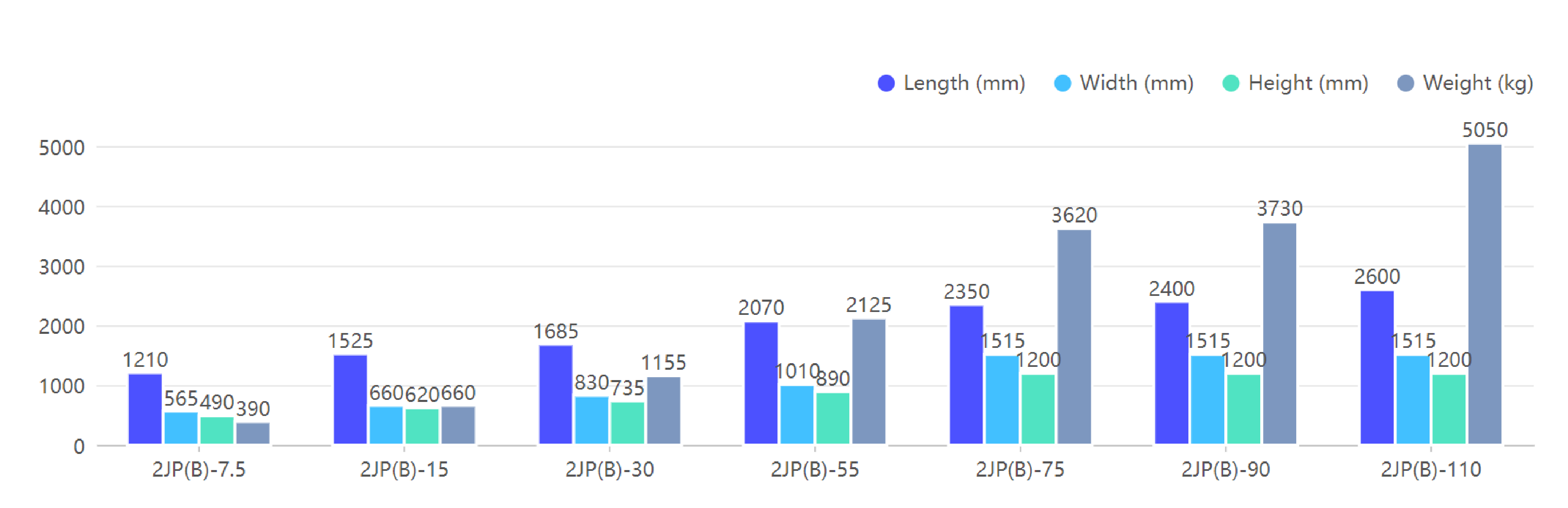
Weight is the silent killer. Any unit above 2 tonnes needs proper handling gear to install. At 5 tonnes (the 2JP(B)-110), you're talking about serious lifting and anchoring. Your ground conditions need to handle that weight without settling.
Width matters for drift access. The 2JP(B)-55 at 1010 mm wide might just squeeze through a narrow decline. The 1.5-metre-wide models (75 kW and up) need wide roadways or may need to be disassembled for transport.
Height often gets overlooked. At 1200 mm tall, the larger units won't fit in a 1.2-metre-high heading without modifications. Check your clearance before committing.
Step 5: The Practical Decision Matrix
Here's how it actually plays out in the real world, based on typical underground conditions:
For short hauls (under 80 metres) in tight spaces: The 2JP(B)-15 or 30 gives you enough pulling power without the weight and size penalties. They're easy to move and install.
For medium hauls (80-120 metres) with standard ore: The 2JP(B)-55 is your workhorse. 50 kN of pulling force, 100 metres of rope capacity, and still under 2.2 tonnes. It fits most drifts and delivers reliable performance.
For long hauls (over 120 metres): You need the 2JP(B)-75. That 190-metre rope capacity is the feature that makes this model essential for long drifts. The weight goes up to 3.6 tonnes, but the reach justifies it.
For high production in tough conditions: The 2JP(B)-110 is the heavy lifter. 80 kN of pulling force, a 1.4 m³ bucket, and the power to handle difficult material. Just plan for the 5-tonne installation.
Common Mistakes in Scraper Winch Selection
Oversizing for peak loads. Some buyers pick the biggest model available "just in case." The problem is that 5-tonne winches need 5-tonne foundations, 5-tonne transport arrangements, and 5-tonne maintenance efforts. If your actual load only needs the 55 kW unit, the 110 kW model costs you far more than the purchase price.
Ignoring rope diameter constraints. Look at the required wire rope diameters: the 2JP(B)-110 uses 23.5 mm working rope. That's heavy, stiff, and expensive. Your supply chain needs to stock that size. Your crews need to handle it. If you currently use 15 mm rope everywhere, a 23.5 mm requirement is a logistics problem.
Forgetting about the return sheave. The longest haul distances require a tail sheave far out in the stope. Your rope capacity might cover the distance, but the sheave position and anchoring matter just as much. Some layouts simply can't accommodate a 200-metre rope run.
Assuming the bucket volume automatically scales. The 1.4 m³ bucket is available on the 90 kW and 110 kW models. But your ore pass or crusher feed arrangement might not handle that volume per cycle. The bucket needs to fit the whole system, not just the winch.
The Bottom Line
The 2JP(B) range covers almost every scraper winch application you'll encounter underground. The key is matching the spec to the actual job, not to what looks good on a spreadsheet.
Start with your constraints—distance, space, power. Then match the capacity—rope length has to cover the haul, pulling force has to move the material. Finally, check the physical fit—if it doesn't fit or can't be installed, nothing else matters.
And remember: the "B" in 2JPB matters. If you're in a coal mine or any gassy environment, you need the flameproof motor. If you're in hard rock metal mining, the standard 2JP series works fine.
The right winch makes a difference you'll notice every shift. The wrong one makes problems you'll deal with for years.
Need help applying this to your specific mine conditions? Send us your haul distance, planned bucket size, and material type, and we'll recommend the exact model for your operation.
Sabrina He | Mining Machinery Specialist
With over 14 years of experience in the mining equipment industry, Sabrina He specializes in machinery selection, technical troubleshooting, and plant optimization.