Welcome to Changsha Mining Equipment Co., Ltd.
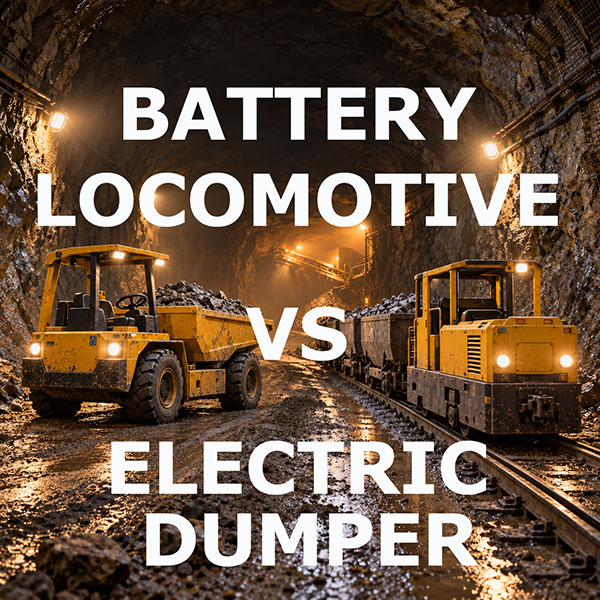
Battery Mine Locomotive vs. Electric Mine Dumper: Which Is Better for a Small Underground Mine?
Imagine a small underground gold mine with a 3-meter-wide, 3-meter-high tunnel, a 400-meter haulage distance, an 8% gradient, and a daily production target of 80 tonnes.
Should the mine install railway tracks and use a battery locomotive, or choose small electric mining dumpers?
For this particular mine, we would start with electric dumpers. Here's why:
The 8% gradient is a major concern for conventional rail haulage. A battery locomotive would need a detailed traction and braking assessment before it could be considered suitable.
Three 2-tonne-class electric dumpers are a reasonable budgeting starting point. At an assumed 1.6-tonne actual load, a 15-minute cycle, and six productive hours, two vehicles would fall slightly short of the daily target.
Building a new railway may be hard to justify economically. If the mine needs a much longer route to reduce the gradient, infrastructure costs could outweigh operating savings. In our illustrative calculation, the track investment alone takes around ten years to recover.
These are preliminary judgments based on a hypothetical mine, not final equipment specifications or quotations.
1. Why the 8% Gradient Makes Rail Haulage Difficult
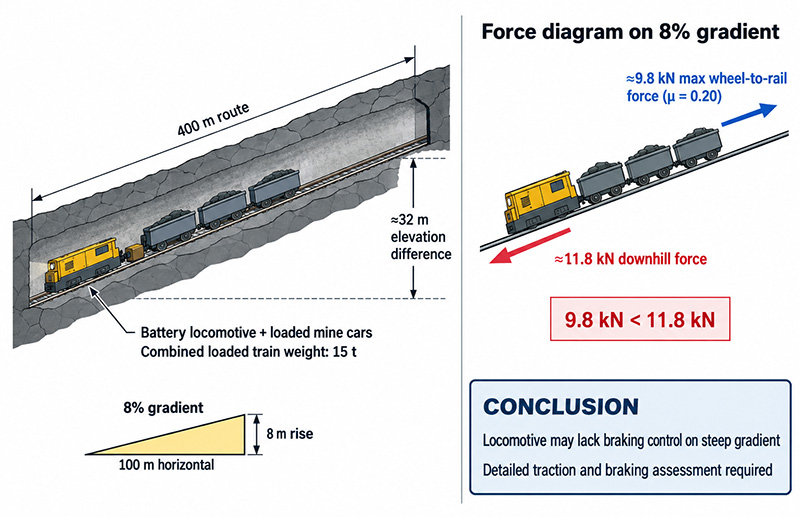
An 8% gradient means the roadway rises 8 meters for every 100 meters of horizontal distance. Over the full 400-meter route, the elevation difference is about 32 meters.
For a battery locomotive, the issue is not just whether its motors can climb the slope. It is whether the locomotive can maintain traction uphill and safely control the loaded train downhill.
Consider a simplified example. A 5-tonne battery locomotive pulls mine cars with a combined loaded train weight of 15 tonnes.
On an 8% gradient, gravity produces about 11.8 kN of force pulling the train downhill.
Assume the effective wheel-to-rail adhesion coefficient is 0.20. Under this condition, the locomotive's 5 tonnes of adhesive weight provides a maximum wheel-to-rail force of about 9.8 kN.
That is less than the downhill gravitational force on the entire train.
This simplified comparison ignores rolling resistance, independently braked mine cars, and other braking systems. Nor is 0.20 a guaranteed adhesion coefficient. But it shows the problem: a locomotive that looks powerful enough on paper may not control a heavy train on a steep incline using wheel adhesion alone.
Wet rails, wheel slip, and braking arrangements become critical.
For this mine, we would not select a conventional battery locomotive based on motor power or advertised traction figures. A verified traction and braking assessment would be needed first.
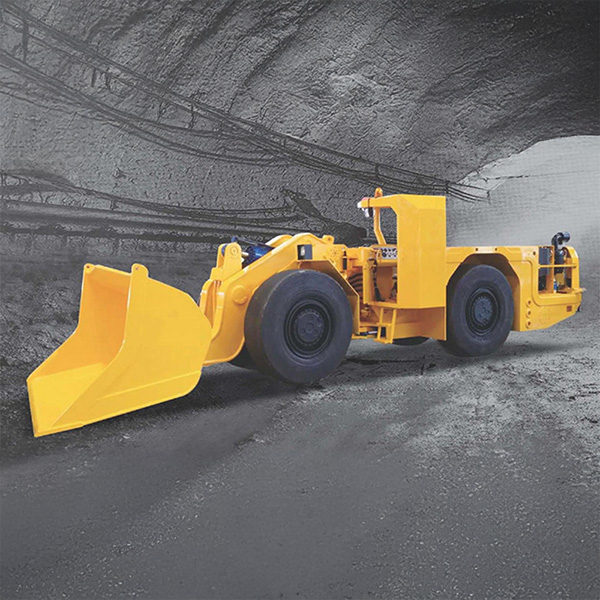
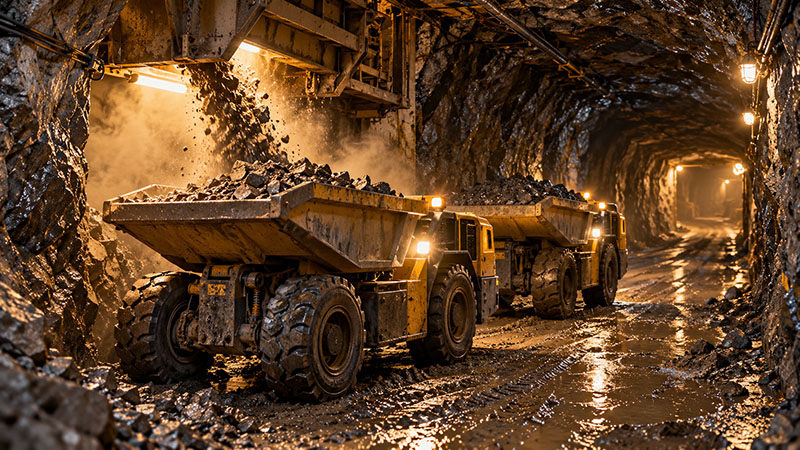
A compact electric dumper is a more practical starting point because it needs no rails. However, it must still be approved for the actual gradient, operating distance, underground conditions, and loaded downhill braking duty.
2. Is a 2-Tonne Electric Dumper Enough for 80 Tonnes per Day?
Assume the mine has six productive haulage hours per day after breaks and other interruptions.
A small electric dumper with a rated payload of 2 tonnes looks like a reasonable candidate. At 2 tonnes per trip, moving 80 tonnes requires 40 loaded trips per day.
But rated payload and actual ore load are not always the same.
Consider a dumper with a 1.1 m³ cargo bed. If the loose ore has an assumed bulk density of 1.8 tonnes per cubic meter, a completely filled bed holds about 1.98 tonnes. In practice, the bed may not be filled to its full geometric volume. Material shape, loading method, and operating restrictions can reduce the usable load.
Suppose the actual average load is 1.6 tonnes per trip. The mine now needs 50 loaded trips to move 80 tonnes.
Assume one complete cycle — loading, traveling 400 meters to the discharge point, unloading, and returning empty — takes 15 minutes. In six productive hours, one vehicle completes 24 trips.
Two vehicles would therefore transport:
2 × 24 × 1.6 = 76.8 tonnes per day.
They fall short of the 80-tonne target.
There are two practical fixes.
The first is to keep two vehicles but shorten the average cycle to 14.4 minutes, or extend productive haulage time from six hours to six hours and 15 minutes. Either change would allow 50 trips under these assumptions.
The second is to use three 2-tonne-class dumpers. Each then needs only 17 trips to move a combined 81.6 tonnes, allowing an average cycle of about 21 minutes within the same six-hour period.
For a strict six-hour window, we would provisionally budget for three 2-tonne-class dumpers rather than rely on two vehicles consistently achieving a near-perfect cycle.
That does not mean three vehicles are always the cheapest option. If loading times are predictable and a slightly longer shift is possible, two may be sufficient.
What about 3.5-tonne dumpers? A larger rated payload does not automatically solve the problem. If the cargo bed is only slightly larger, the actual ore load may remain limited by volume rather than payload capacity.
Before upgrading, the mine should check usable cargo volume, loose ore density, safe load on the incline, and realistic cycle time.
The more useful purchasing question is not "Which dumper has the highest payload?" but "Which combination of actual load and cycle time can reliably move 80 tonnes within our working shift?"
3. Would Installing a Railway Save Money Over Time?
Battery locomotives can offer economic advantages on established haulage levels where loaded mine cars travel repeatedly along a fixed route.
But our example mine has a complication: its existing 400-meter route climbs at 8%.
Suppose the mine wants an alternative rail route with an average gradient of just 2%. This is an illustrative design target, not an approved operating gradient.
To overcome the same 32-meter elevation difference, the alternative route would need to be at least about 1,600 meters long — four times the original distance.
This changes the economics considerably.
For illustration, assume installed railway track costs $75 per meter. A 1,600-meter railway would cost approximately $120,000 for the track alone.
This excludes new tunnel excavation, the battery locomotive, mine cars, loading arrangements, charging facilities, and other infrastructure. The $75 figure is only a calculation assumption, not a market quotation.
Now consider operating costs. Suppose the rail system saves the mine $6,000 per year in vehicle operating labor, $5,000 in tire and brake-related servicing, and $4,000 in roadway maintenance. If rail-specific maintenance adds $3,000 annually, the estimated net saving is $12,000 per year.
At 80 tonnes per day and 250 operating days annually, the mine moves 20,000 tonnes of ore per year. That means the hypothetical saving is $0.60 per tonne.
At this rate, the railway track alone would take approximately 10 years of savings to recover its cost.
And that is an optimistic screening calculation, not a complete payback estimate. The extra locomotive, mine cars, new excavation, and longer haulage distance could make rail transport considerably more expensive. Electricity, battery replacement, and actual labor requirements would also need to be compared.
For a small mine with limited remaining operating life, such an investment would be difficult to justify.
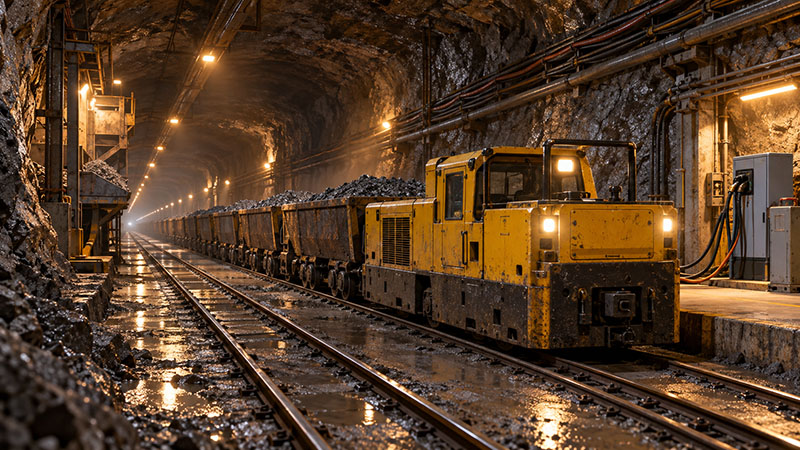
Now consider a different situation. The same mine develops a nearly level main haulage tunnel. Its transport route becomes permanent, production increases, and a substantial volume of ore must travel that route every day.
In this case, a battery locomotive pulling multiple mine cars becomes much more attractive. The railway no longer needs a lengthy detour to avoid a steep incline, and the mine can spread infrastructure costs over a larger volume of material and a longer operating period.
That is where rail haulage deserves a serious financial comparison.
For our original 80-tonne-per-day mine, we would focus on a properly sized electric dumper fleet, subject to verification of the vehicles' underground and slope performance. For a mine with a stable, gently graded haulage level and sustained higher transport volumes, we would evaluate a battery locomotive and mine car system instead.
If you are comparing these options for your own mine, the most useful starting point is a simple haulage profile showing route length, gradients, tunnel dimensions, daily tonnage, and available operating hours. Those details can reveal much more about the right equipment than a catalogue's rated payload alone.
Sabrina He | Mining Machinery Specialist
With over 14 years of experience in the mining equipment industry, Sabrina He specializes in machinery selection, technical troubleshooting, and plant optimization.