Welcome to Changsha Mining Equipment Co., Ltd.
When Should an Underground Mine Upgrade Its Hoist? Lessons from South African Gold Mines
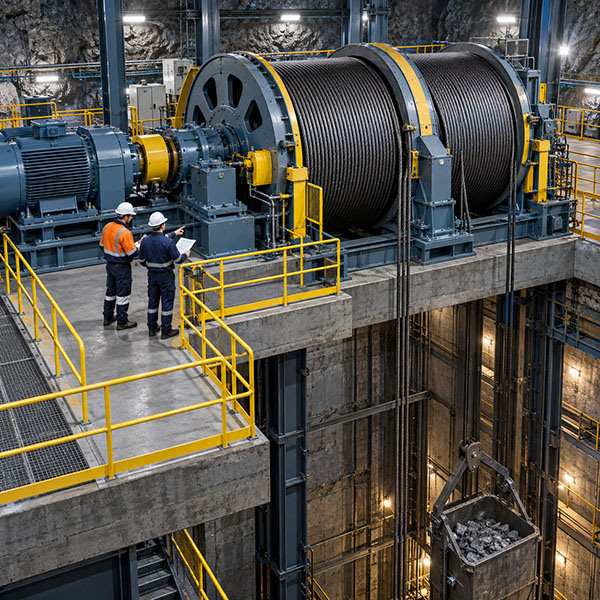
Ore waiting at the bottom of a shaft, frequent hoist stoppages, longer lifting cycles, or production delays as mining moves deeper—these are common warning signs that an underground mine's hoisting system may no longer meet its operational needs.
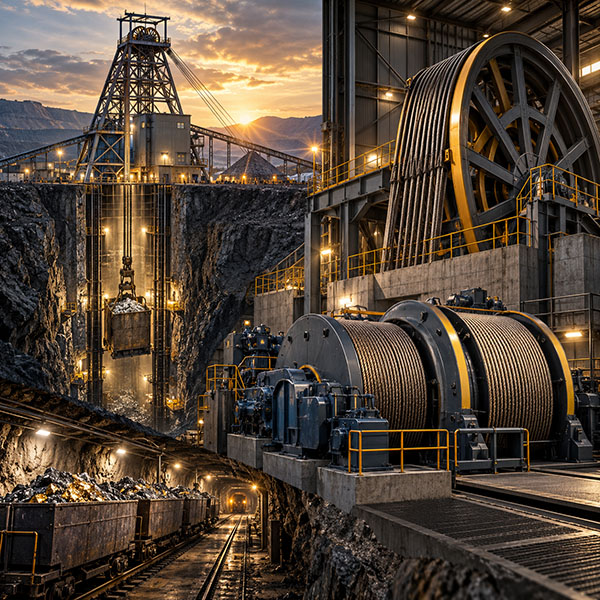
A mine hoist is essential for transporting ore, personnel, and materials between underground levels and the surface. When its capacity or reliability becomes insufficient, the entire mining operation can be affected.
But when should a mine upgrade its hoist, and when is a complete replacement necessary?
Recent developments at South Africa's Fairview and Evander gold mines highlight the importance of reliable hoisting infrastructure. Their experience also provides valuable insights for mine operators considering single-drum, double-drum, or multi-rope friction hoisting systems.
1. South African Gold Mines Highlight the Value of Hoist Upgrades
In its September 2026 annual results presentation, Pan African Resources highlighted infrastructure improvements at two of its major underground gold mining operations.
Fairview Mine: Improving Ore Transport Reliability
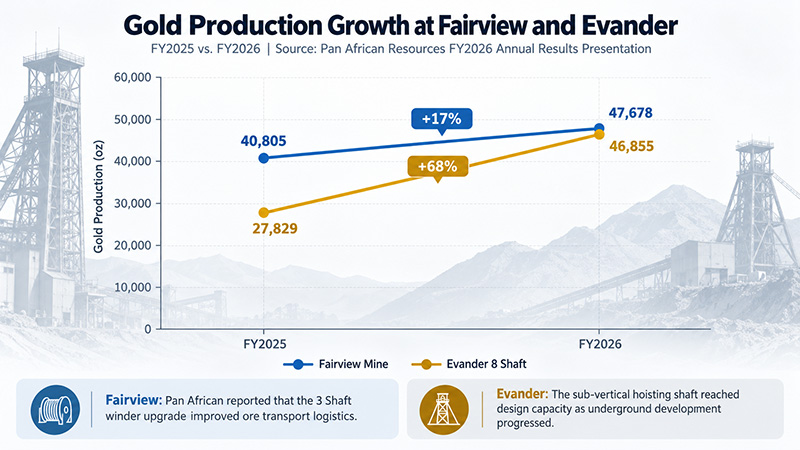
At Fairview Mine, part of the Barberton Mines complex, gold production increased by 17% to 47,678 ounces in FY2026, compared with 40,805 ounces in FY2025.
According to Pan African Resources, the completed 3 Shaft winder upgrade has improved ore transport logistics. The company also continues to develop underground access infrastructure to improve hoisting availability.
The upgrade had been completed before the September 2026 report, which discusses its contribution to ongoing operations.
Importantly, the company has not published a separate percentage increase in hoisting capacity or reduction in downtime attributable solely to the winder upgrade.
The production improvement reflects several factors, including mining flexibility, ore grades, and infrastructure improvements. Nevertheless, the case demonstrates why reliable hoisting equipment remains important for established underground mines.
Evander Mine: Supporting Deeper Underground Development
At Evander's 8 Shaft complex, gold production increased by 68% to 46,855 ounces in FY2026, compared with 27,829 ounces the previous year.
Pan African Resources reported that its sub-vertical hoisting shaft was operating at design capacity. The improved ore-handling arrangement replaced approximately four kilometers of conveyor infrastructure.
Meanwhile, development continues around the 24 and 25 Levels as the mine advances toward deeper mineral resources.
Although the production increase cannot be attributed exclusively to the hoisting system, the project illustrates how shaft infrastructure, underground development, and material handling must work together.
For mine operators, the lesson is clear: improving underground production requires sufficient and reliable hoisting capacity.
Source: Pan African Resources — FY2026 Annual Results Presentation, pages 27–28.
2. Five Warning Signs Your Mine Hoist May Need an Upgrade
Not every underground mine requires a new hoist. However, several operating conditions may indicate that the existing system needs evaluation.
1. Frequent Unplanned Downtime
Repeated mechanical failures, braking problems, or electrical faults can interrupt ore transportation and affect production schedules.
If maintenance costs and equipment downtime continue to increase, upgrading critical components or replacing the hoist may become necessary.
2. Insufficient Hoisting Capacity
When underground production exceeds the amount of ore that can be transported through the shaft, material may accumulate at loading stations.
Operators should compare actual hoisting throughput with production requirements before determining whether greater lifting capacity is needed.
3. Increasing Mining Depth
As mining extends to deeper levels, longer hoisting distances may increase cycle times and change rope-loading conditions.
The existing hoist must be evaluated against the new operating depth, rope requirements, and production targets.
4. Outdated Control and Safety Systems
Older hoisting equipment may use control systems or components that are difficult to maintain.
Modernization may improve monitoring, operational control, and equipment reliability. All changes must satisfy applicable mine safety requirements.
5. Changes in Production Requirements
A mine that initially operated with modest production volumes may eventually require more frequent lifting cycles or different conveyance arrangements.
In such cases, the original hoist configuration may no longer be suitable.
3. Single-Drum vs. Double-Drum vs. Multi-Rope Friction Hoists
Understanding how different mine hoists operate is essential before selecting replacement equipment.
The main difference is how each system transmits motion to the steel wire ropes.
Single-Drum Winding Hoist
A single-drum hoist uses one rotating drum to wind and unwind a steel wire rope.
As the drum winds the rope, the connected skip or cage rises. Controlled unwinding allows the conveyance to descend.
Single-drum configurations offer relatively straightforward mechanical arrangements and can be suitable for auxiliary hoisting, inclined shafts, and certain single-conveyance applications.
Double-Drum Winding Hoist
A double-drum mine hoist uses two drums to operate two hoisting ropes.
In a typical two-conveyance system, one drum winds its rope while the other releases rope, allowing one conveyance to rise as the other descends.
This arrangement can provide a balancing effect and operational flexibility, particularly in mines requiring coordinated hoisting between different levels.
The CSME 2JK series uses this double-drum winding principle.
Multi-Rope Friction Hoist
Unlike winding hoists, multi-rope friction hoists do not store the hoisting ropes on a drum.
Instead, multiple steel wire ropes pass over a driven friction wheel. Friction between the ropes and wheel lining transfers motion to the lifting system.
The ropes typically connect two conveyances or a conveyance and counterweight.
This arrangement distributes the suspended load across several ropes and avoids the need for a large rope-storage drum.
The CSME JKMD series adopts this multi-rope friction principle.
However, friction hoists require careful consideration of rope tension balance, friction conditions, shaft layout, and operating requirements.
4. Comparing CSME 2JK and JKMD Mine Hoists
To illustrate the technical differences, consider two models from the CSME product range.
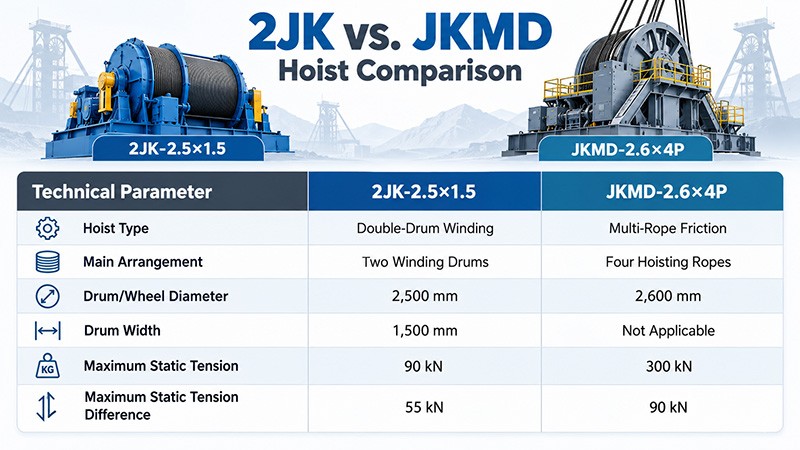
Specifications are based on CSME technical catalogues. Actual equipment configuration must be verified against project requirements.
What Does 300 kN vs. 90 kN Mean?
The JKMD-2.6×4P has a higher listed maximum static tension than the 2JK-2.5×1.5.
This indicates a different rated suspended-load capability and may make the JKMD configuration suitable for applications involving greater total hoisting-rope loads.
However, maximum static tension is not the same as useful ore payload.
The suspended load includes the weight of the hoisting ropes, conveyance, attachments, and transported material.
Furthermore, the two models use different rope arrangements, meaning their ratings should not be compared as direct measures of ore-lifting capacity.
Maximum static tension difference is another critical parameter. It describes the allowable imbalance between the two sides of the hoisting system.
For friction hoists, this difference is particularly important because sufficient traction must be maintained between the ropes and friction wheel.
A higher-rated hoist may also require different structural support, foundations, and shaft arrangements. These requirements must be established through engineering calculations rather than static-tension ratings alone.
Therefore, mine depth, actual payload, rope configuration, and required production capacity should determine hoist selection—not simply the largest tension rating.
5. What Should Engineers Evaluate Before Upgrading?
Before choosing between winding and friction hoists, operators should review the complete lifting system.
Shaft depth and configuration
Determine the total lifting distance, shaft inclination, available installation space, and existing infrastructure.
Required payload and throughput
Calculate the weight of the conveyance, transported material, steel wire ropes, and associated components.
Required hourly production should also be considered alongside the total lifting cycle.
Hoisting speed and operating cycle
Maximum hoisting speed alone does not determine production capacity.
Loading time, acceleration, deceleration, unloading, and equipment availability all influence actual throughput.
Power supply and control system
Evaluate the available electrical infrastructure, motor requirements, control equipment, and braking systems.
Safety and regulatory requirements
All mine hoisting installations must meet applicable engineering standards and local mining regulations.
Existing equipment should be inspected by qualified professionals before any significant modernization or replacement.
6. Why Underground Haulage Matters Just as Much
Upgrading a mine hoist does not automatically eliminate underground transportation bottlenecks.
Ore must first reach the shaft loading station.
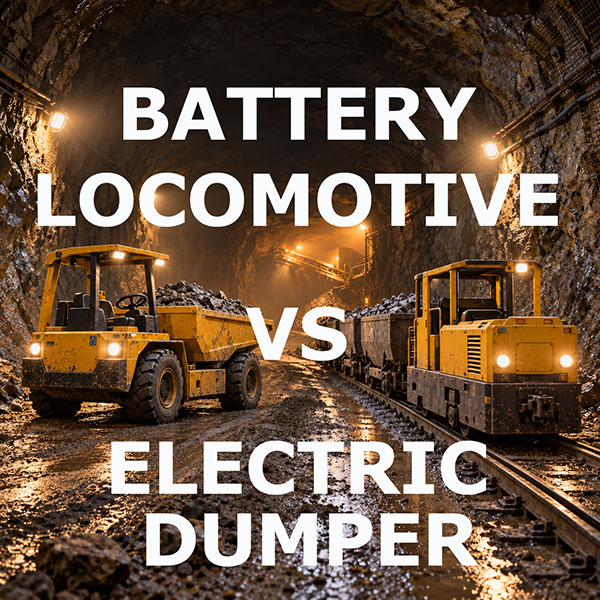
In rail-based mining operations, battery locomotives, mine cars, and steel rails form an important part of the underground haulage system.
If ore cannot be delivered efficiently to the loading point, increasing hoisting capacity may provide limited benefits.
The Evander project demonstrates the importance of coordinating shaft hoisting with broader underground transport infrastructure.
For mines planning expansion, engineers should evaluate the complete material-handling process, from the working face to the surface.
7. Frequently Asked Questions
Is a double-drum hoist better than a single-drum hoist?
Not necessarily. Double-drum hoists can provide balancing and operational flexibility, while single-drum systems may be suitable for simpler lifting arrangements.
The correct choice depends on the shaft and operating requirements.
Are multi-rope friction hoists suitable for deep mines?
They are widely used in many demanding vertical-shaft applications, including deep mines.
However, suitability depends on shaft depth, rope loads, traction requirements, conveyance arrangement, and other engineering factors.
Does upgrading a mine hoist require replacing the entire machine?
No. Some modernization projects involve replacing control systems, drives, brakes, or other components.
Complete replacement should be considered when the existing equipment cannot safely or economically meet the required operating conditions.
8. Planning Your Next Mine Hoist Upgrade
The Fairview and Evander examples highlight the importance of reliable shaft hoisting infrastructure as underground mining operations evolve.
Whether your project requires a double-drum winding hoist or a multi-rope friction hoist, selecting the appropriate configuration begins with understanding your mine's operating conditions.
CSME offers 2JK double-drum winding hoists and JKMD multi-rope friction hoists for international mining projects.
If you are planning a new installation or evaluating an existing hoisting system, we welcome you to contact our engineering team.
Simply share your shaft depth, required lifting capacity, operating conditions, and available power supply.
Our team will be happy to review your requirements and recommend a preliminary hoist configuration suited to your mining project.
Sabrina He | Mining Machinery Specialist
With over 14 years of experience in the mining equipment industry, Sabrina He specializes in machinery selection, technical troubleshooting, and plant optimization.