Welcome to Changsha Mining Equipment Co., Ltd.
The Complete Guide to Scraper Winches: Principles, Applications, and FAQs
Introduction
In the challenging environment of underground mining, where space is tight and reliability is non-negotiable, the scraper winch remains an indispensable workhorse. Unlike bulky mobile equipment, a scraper winch is a heavy-duty machine designed for the short-distance transport of ore or waste rock using a wire rope and a scraper bucket. Its simple mechanics allow it to operate in harsh conditions where advanced electronics might fail.
This guide will provide a complete technical overview of scraper winches, covering their working principles, real-world applications in metal and coal mines, a practical selection guide for the 2JP(B) series, and answers to frequently asked questions.
Core Technology: How Does a Scraper Winch Work?
To truly understand the reliability of this machinery, we must break down its core structure and the elegant reciprocating motion that defines its operation.
The Core Structure
A scraper winch system consists of three essential components:
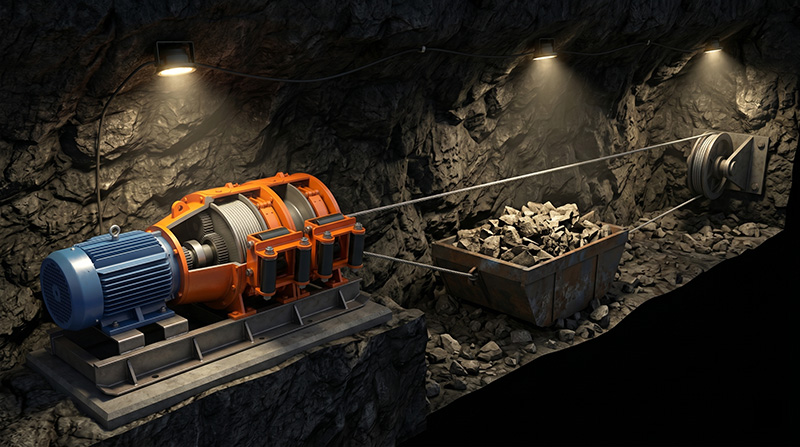
The Double-Drum Winch: This is the heart of the system, comprising an electric motor, a reducer, and two distinct drums (the working drum and the return drum).
The Wire Ropes: These include the main rope for pulling the load and the tail rope for returning the empty bucket.
The Scraper Bucket: A heavy-duty steel bucket designed to dig into the muck pile and carry material.
The Reciprocating Motion
The operation occurs in two distinct phases, controlled by clutches on the winch unit:
Phase 1: The Loaded Pull (Pulling Phase). The operator engages the main working drum. This drum rotates, winding the main rope and releasing the tail rope simultaneously. The main rope drags the loaded scraper bucket across the mine floor, pulling the ore to the unloading point, such as an ore pass or a conveyor.
Phase 2: The Empty Return (Return Phase). Once the material is discharged, the operator switches the clutches. This engages the return drum, which starts winding the tail rope while the working drum releases. The tail rope runs through a return sheave (tail pulley) at the back of the working face, quickly pulling the empty bucket back to the muck pile for the next load.
This purely mechanical reciprocating cycle is the secret to the scraper winch’s extremely low failure rate. Without relying on complex hydraulics or sensitive sensors, it provides continuous, high-efficiency operation in dusty, wet, and abrasive environments.
Real-World Applications: Where Are Scraper Winches Used?
Scraper winches thrive in scenarios where larger Load-Haul-Dump (LHD) machines simply cannot fit or are too costly to operate.
1. Narrow Vein Metal Mining
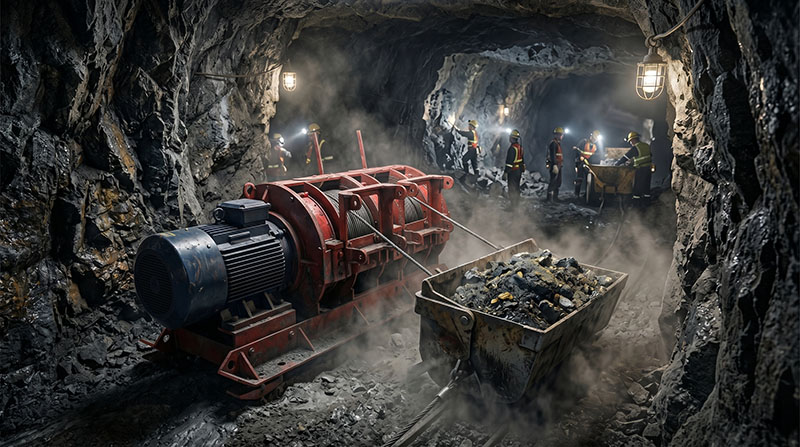
In precious metal mines, such as gold or copper, ore bodies are often extremely narrow. Large diesel-powered LHDs cannot access these stopes without significant and costly dilution (blasting extra waste rock to create a wider tunnel). A small-profile scraper winch can be installed in a narrow alley. It efficiently scrapes the blasted, high-hardness, abrasive ore along the drift floor directly to the ore pass. This minimizes waste dilution and maximizes ore recovery in steeply dipping or flat-lying veins.
2. Coal Mine Backfilling and Stowing
With the rise of green mining practices, immediate backfilling of mined-out areas (goafs) is critical for ground stability. Scraper winches are commonly used to spread waste rock or paste fill material evenly across the void. Because the winch can operate stably on slopes of less than 30 degrees, it is the ideal equipment for distributing material in inclined stopes. It does not require a flat, graded road like a truck would, making it perfect for uneven underground cavities.
3. The Bottom Structures of Block Caving Mines
In mass mining methods like block caving or sublevel caving, the ore funnels down to drawpoints in the mine’s bottom structure. Here, stationary scraper winches are installed in dedicated scraper drifts. They serve as the "throat" of the mine, continuously scraping the massive influx of ore from the drawpoints directly to the crusher or main haulage level. This stationary configuration handles a massive volume of material with minimal maintenance downtime.
Selection Guide & 2JP(B) Series Parameter Highlights
Choosing the right model is critical for optimizing cost per ton. The 2JP(B) series offers a full range to match specific site conditions.
Drift Width and Bucket Volume: Space is a premium underground. For extremely narrow stopes, a compact unit like the 2JP(B)-7.5 is necessary. With a small 0.1 m³ bucket and a machine width of only 565mm, it fits where other machines cannot. For main transportation drifts, the 2JP(B)-110 can handle a massive 1.4 m³ bucket for peak productivity.
Pulling Force and Power: You must match the motor to the ore density and slope. For dense, heavy ore on an incline, you need high tractive effort. Our series spans from 7.5kW to 110kW. The top-tier models deliver a maximum tractive force of up to 80 kN, providing the muscle needed for heavy-duty scraping without stalling.
Rope Capacity and Scraping Distance: The effective working distance is defined by the drum’s rope capacity. If your stope is long, you need a model with ample tail rope capacity. For instance, the 2JP(B)-75 offers a remarkable return-drum rope capacity of up to 210 meters, making it highly effective for long-distance continuous scraping without frequent repositioning.
Frequently Asked Questions (FAQ)
Q1: What does the "2" in the 2JP(B) series stand for?
A: The "2" signifies a Double Drum configuration. This structural design is the foundation that enables the critical reciprocating motion—allowing one drum to pull the loaded bucket while the other releases the empty return rope. Without this dual-drum clutch system, continuous cycle operation wouldn't be possible.
Q2: What is the maximum incline angle for operation?
A: While efficient in horizontal drifts, the scraper winch is also designed for inclined mining. It operates reliably on slopes typically less than or equal to 30 degrees. This capability makes it suitable for following the natural angle of an inclined ore body, handling material on a surface where a rubber-tired vehicle would lose traction.
Q3: How do I choose the correct scraper bucket size?
A: Bucket size must match the winch’s pulling power to prevent motor overload and mechanical failure. A small 0.1 m³ bucket fits the 7.5kW winch in light scraping. In contrast, a large, heavy-duty 1.4 m³ rock bucket requires the high power output of a 90kW or 110kW motor. Using a bucket that is too large for your model risks burning out the motor and snapping wire ropes.
Conclusion & Call to Action
Selecting the right scraper winch is a strategic decision that directly impacts your mine’s safety, operational efficiency, and cost per ton. By matching the geology to the machine, you ensure decades of reliable service.
Are you searching for a high-performance, cost-effective scraping solution for your mine? Browse our complete technical brochures for the 2JP(B) series today, or contact our equipment specialists directly for a custom quote tailored to your site conditions.
Sabrina He | Mining Machinery Specialist
With over 14 years of experience in the mining equipment industry, Sabrina He specializes in machinery selection, technical troubleshooting, and plant optimization.