Welcome to Changsha Mining Equipment Co., Ltd.
5-Ton Battery Locomotive Gearbox: Structure Anatomy & Technical Specifications
Introduction
The gearbox serves as the mechanical heart of the 5-ton battery locomotive, responsible for transmitting power efficiently under the most demanding mining and tunneling conditions. Without a properly functioning transmission system, even the most powerful locomotive becomes immobile. This article provides a comprehensive breakdown of the core transmission mechanism, structural design, bearing configurations, lubrication guidelines, and essential spare parts—all based on official technical manuals.
Whether you are a maintenance engineer, procurement specialist, or fleet manager, understanding these specifications will help you optimize performance and extend service life. Let's dive into the technical details of the 5-ton battery locomotive gearbox.
Core Transmission Mechanism: Two-Stage Reduction
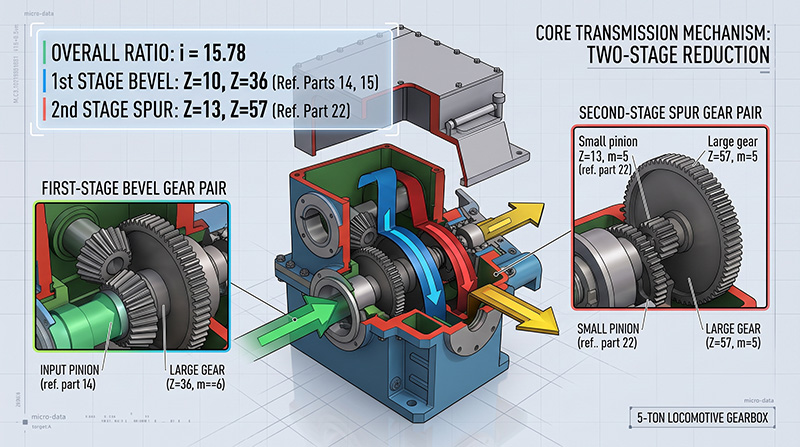
The transmission system of the 5-ton battery locomotive employs a two-stage reduction design, which is the industry standard for achieving high torque output at low rotational speeds—a critical requirement for pulling heavy loads in confined underground spaces.
The total transmission ratio is precisely calculated at i = 15.78, ensuring an optimal balance between traction force and operational speed. This ratio is achieved through two distinct gear stages.
The first stage consists of spur gears, featuring a large spur gear with 57 teeth and a module of 5, paired with a small spur gear with 13 teeth and the same module of 5. The second stage utilizes bevel gears, including a large bevel gear with 36 teeth and a module of 6, along with a small bevel gear with 10 teeth and a module of 6.
This specific gear combination allows the locomotive to convert high-speed motor input into low-speed, high-torque output, making it perfectly suited for hauling 5-ton payloads on steep gradients and rough tracks. The use of both spur and bevel gearing also enables a 90-degree power transmission angle, which is essential for the compact layout of battery-powered mining locomotives.
Structural Design & Bearing Configurations
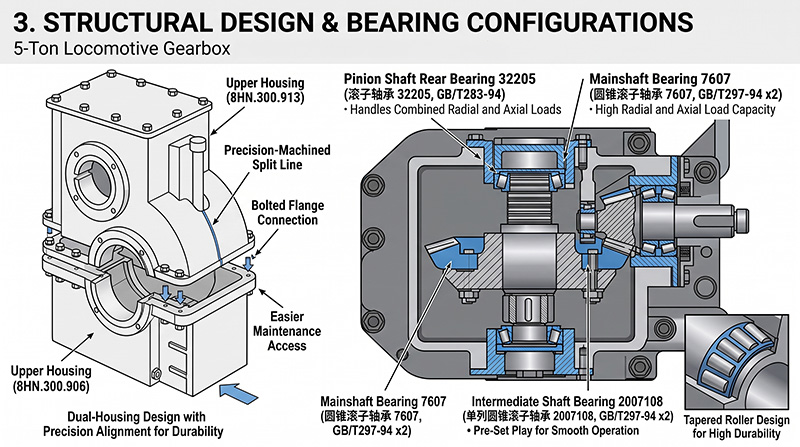
The gearbox housing features a practical split design, consisting of an Upper Housing (8HN.300.913) and a Lower Housing (8HN.300.906). This split construction significantly simplifies daily inspection, maintenance, and part replacement, reducing downtime in busy mining operations.
To withstand the heavy radial and axial loads generated during operation, the gearbox relies on high-precision bearings manufactured in accordance with Chinese national standards. The bearing configuration includes tapered roller bearings (GB/T297-94) in models 7607 and 2007108, designed to handle combined loads with high rigidity, as well as a cylindrical roller bearing (GB/T283-94) in model 32205, providing excellent radial load capacity.
Additional structural components include bearing sleeves (8HN.211.386 and 8HN.211.385), inner covers (8HN.317.1242), adjusting bolts (8HN.946.672), and retaining rings (GB894.1-86). The drive shaft (5HN.200.420) and key (8HN.970.1211) complete the power transmission path from the motor to the wheels. Stop washers (8HN.951.1131 and 8HN.951.1130), a cover (5HN.150.416), a pipe (8HN.170.1104), a plug (8HN.322.623), a bearing cover (8HN.317.1425), an oil seal cover (8HN.307.770), and an oil seal (5HN.370.094) round out the complete assembly.
Lubrication System Guidelines
Proper lubrication is the single most important factor in extending gearbox life and preventing premature failure. The 5-ton battery locomotive gearbox utilizes a splash lubrication system (oil-bath type), where rotating gears distribute oil throughout the housing to ensure all moving parts receive adequate coverage.
The gearbox holds exactly 5 kilograms of oil. The manufacturer specifically recommends a specialized mixture of molybdenum disulfide grease and 50# mechanical oil in a 2:1 ratio. This formulation is specifically designed to provide superior anti-wear protection and extreme-pressure performance under heavy loads.
For maintenance, the lubricant should be injected or replaced every 3 months, which corresponds to approximately 180 shifts under a two-shift operation system. Regular oil changes using the correct lubricant mixture will dramatically reduce gear and bearing wear, prevent overheating, and ensure consistent transmission efficiency throughout the locomotive's service life.
Essential Spare Parts for Inventory
To minimize unplanned downtime and keep your fleet operating at peak performance, we recommend maintaining an inventory of key wear-and-tear components specific to the gearbox. These parts are subject to normal degradation and should be replaced periodically.
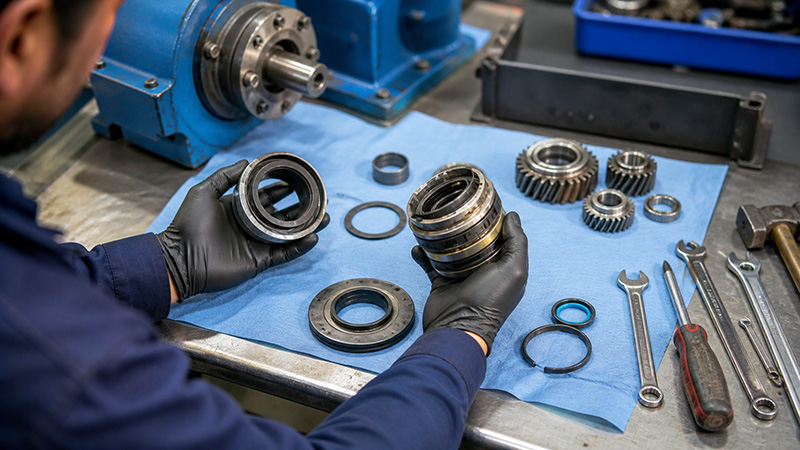
The small spur gear (part number 8.240.460) is a high-wear component that should be replaced proactively to avoid secondary damage to mating gears. Sealing components are equally critical for preventing oil leaks—these include the U-shaped oil seal (80×105×12.5) and the standard oil seal (50×72×12). Additionally, rubber washers (8EB.280.097) and plum coupling pads (commonly known as plum pads) are essential for maintaining proper sealing and coupling alignment.
Having these parts on hand ensures that routine maintenance or emergency repairs can be completed without lengthy procurement delays, keeping your locomotives in service and your operations running smoothly.
Conclusion & Call to Action
The 5-ton battery locomotive gearbox is a precision-engineered assembly that combines robust two-stage reduction gearing, heavy-duty bearing configurations, and a well-designed lubrication system to deliver reliable performance in harsh underground environments. By adhering to the specified maintenance schedules—particularly the 3-month oil change interval with the 2:1 molybdenum disulfide mixture—and keeping critical spare parts in stock, you can ensure safe, smooth, and cost-effective operation for years to come.
Whether you need a complete 5-ton locomotive gearbox assembly, individual OEM replacement parts such as gears, bearings, and oil seals, or technical support for your existing fleet, our team is ready to assist. Contact us today for a quick quote and expert advice tailored to your specific requirements.
Sabrina He | Mining Machinery Specialist
With over 14 years of experience in the mining equipment industry, Sabrina He specializes in machinery selection, technical troubleshooting, and plant optimization.