Welcome to Changsha Mining Equipment Co., Ltd.
Cutting Costs on Mixed Ground: The TRD-800 Mechanical Top Drive Drilling Solution
Why Your Next Drill Rig Should Be a Dual-Purpose Mechanical Top Drive
In the world of water well drilling, geotechnical exploration, and mining, contractors often face a frustrating dilemma. You might start the morning drilling through soft clay and topsoil, only to hit a dense layer of gravel, boulders, or hard bedrock by midday. Traditionally, this required either two different rigs or a massive compromise in productivity.
This is the exact problem the TRD-800 Mechanical Top Drive Core Drill Rig was engineered to solve. By integrating mud rotary and down-the-hole (DTH) hammer drilling into a single, mechanically driven unit, the TRD-800 offers a game-changing approach to complex lithology.
The Problem with Conventional Rigs in Mixed Strata
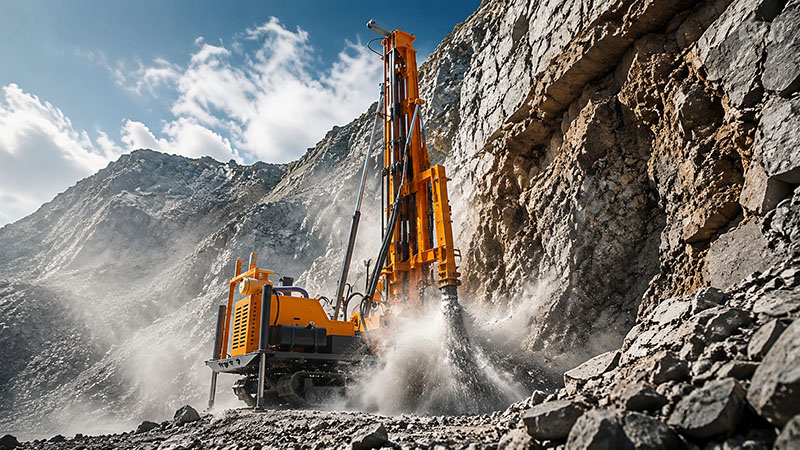
To understand the value of the TRD-800, we need to look at the weaknesses of standard equipment. A purely hydraulic top drive water well rig excels at mud drilling but often wastes significant energy through hydraulic oil heat dissipation. More importantly, when you switch to air drilling for hard rock using a DTH hammer, the hydraulic system’s flow demands and energy losses can skyrocket.
Conversely, a pure air rig struggles in unconsolidated soil. Without mud to stabilize the borehole, you risk constant collapse. This forces contractors to own multiple rigs, increasing capital expenditure and transportation logistics. The TRD-800 was designed as the answer to this inefficiency, serving as a true “all-terrain” drilling asset.
Mechanical Top Drive: The Heart of Efficiency
The standout feature of the TRD-800 is its mechanical top drive head combined with a long-stroke double-speed mechanism. Unlike hydraulic drives that rely on pumps and motors, the TRD-800 uses a mechanical transmission system. What does this mean for your daily operations?
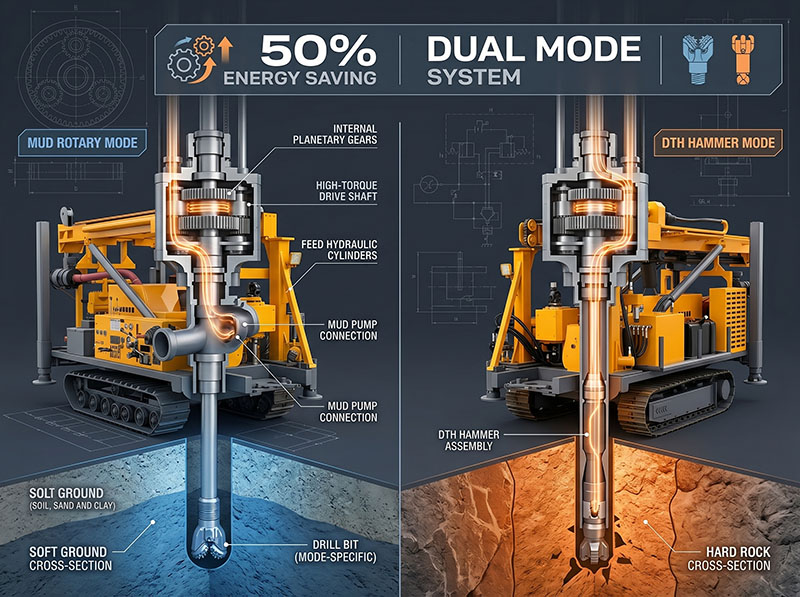
1. 50% Reduction in Energy Consumption
Because mechanical transmission is inherently more direct, the power transmission efficiency is doubled compared to hydraulic systems. There is minimal power loss through fluid friction. For the drilling contractor, this translates directly to lower fuel or electricity bills—often a 30-40% reduction in energy costs on comparable drilling footage.
2. Precision and Speed Control
The mechanical rotary head provides consistent torque. Coupled with the long-stroke feed system, the rig significantly reduces the risk of “stuck pipe” or “burnt bits” . The fast response of the mechanical hoist also means you can clear blockages and handle down-hole complications much faster than with a standard hydraulic winch.
Seamless Switching Between Mud and Air
Perhaps the biggest commercial advantage of the TRD-800 is its functional integration of mud rotary and DTH hammer drilling. The hydraulic control system is pre-engineered with spare function interfaces. This doesn’t just mean you can switch between methods; it means the rig is future-proof.
In Soft Formations: Use the mud pump to circulate drilling fluid, sealing the borehole walls and carrying cuttings to the surface smoothly.
In Hard Rock, Gravel, or Boulder Layers: Instantly switch to the high-compressor air-powered DTH hammer. The TRD-800 handles the back-pressure and feed rate perfectly, smashing through quartzite or granite that would stun a standard mud rig.
This dual functionality eliminates the downtime required to demobilize a mud rig and move in an air rig. You drill faster through the gravel, hit the bedrock, and keep moving. For a water well project spanning 100 meters with mixed geology, the TRD-800 can halve the project timeline.
Designed for the Contractor’s Reality
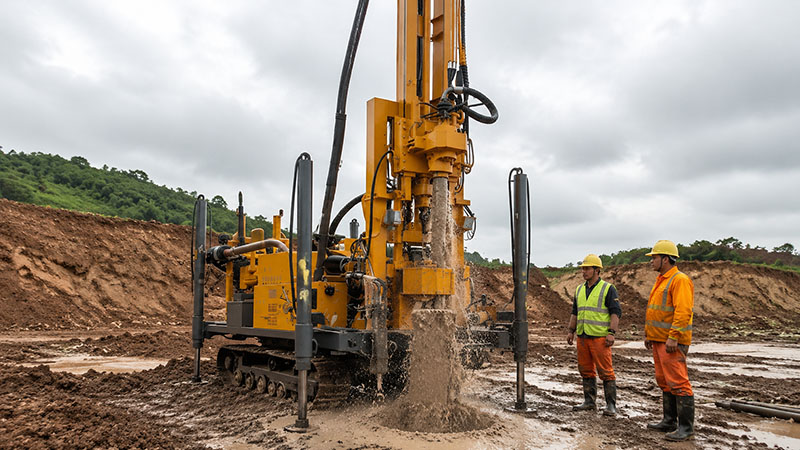
The developers of the TRD-800 clearly understood field conditions. The mechanical winch offers high-speed lifting, making it easy to pull tools out of deep holes quickly for bit changes or emergency handling. Furthermore, the structural stability of the mechanical drive reduces vibration fatigue on the mast, extending the lifespan of the rig.
The reserved hydraulic interfaces are a key selling point for specialized drilling companies. Whether you need to integrate a specific core barrel system or an auxiliary mud cleaner, the TRD-800’s control system is ready to connect.
Conclusion: Maximizing ROI in Challenging Geology
The drilling market is competitive, and profit margins are tight. Investing in a single-function rig limits the contracts you can bid on. The TRD-800 mechanical top drive rig breaks these barriers. It combines the hole-stabilizing safety of mud drilling with the bone-shattering speed of DTH air hammering, all while halving your energy transmission losses through mechanical efficiency.
If you are tired of watching your fuel gauge drop while your penetration rate stalls in broken formation, it’s time to look at the TRD-800. It’s not just a drill rig; it’s a versatile tool designed to make you money in both clay and granite.
Inquire About the TRD-800 Technical Specs Today
Sabrina He | Mining Machinery Specialist
With over 14 years of experience in the mining equipment industry, Sabrina He specializes in machinery selection, technical troubleshooting, and plant optimization.