Welcome to Changsha Mining Equipment Co., Ltd.
The Ultimate Guide to Mine Hoisting Systems: The Lifeline of Underground Mining
The mining industry is often obsessed with drilling deeper and blasting harder, but there is a silent, unsung bottleneck that determines whether a mine is a goldmine or a money pit: Vertical Transportation.
You can blast all the ore you want at the bottom of the shaft, but if you can't get it to the surface efficiently, your operation stops. Conversely, if you can't get your crew down to the face safely, there is no operation at all.
Think of a mine hoisting system as the world's toughest, most muscular industrial elevator. It's the heartbeat and the spine of the underground world. Whether you are a Mine Owner in Africa, a Procurement Manager in South America, or an Engineer in Southeast Asia, understanding how this "lifeline" works is crucial. This guide breaks down the complex engineering of a mine hoist system into simple, business-focused terms.
How the Entire Hoisting System Works: The Big Picture
Before diving into the metal and motors, let's look at the overall workflow. The principle is surprisingly simple, even if the forces involved are massive.
Imagine a spool of thread on a table. You drape the thread over a pulley nailed high on the wall, and tie a heavy weight to the end hanging down. When you crank the spool, the weight rises. When you release the crank, the weight descends.
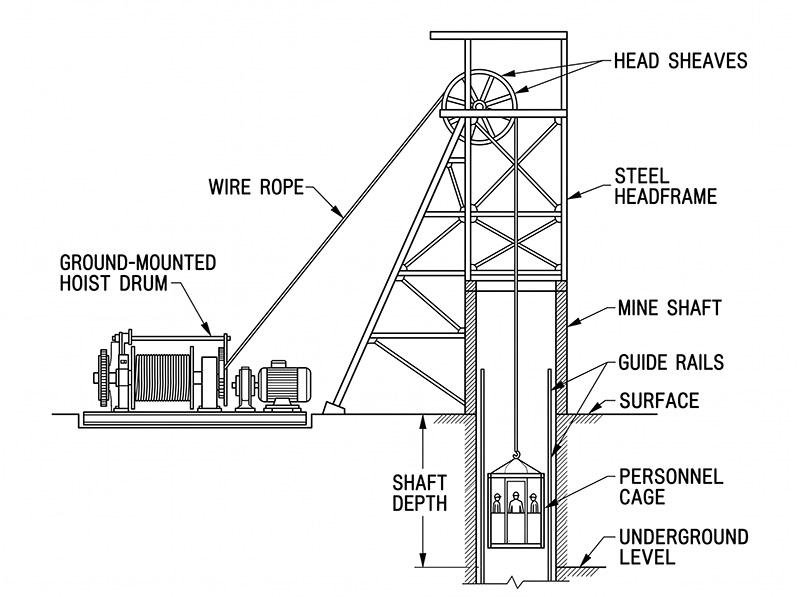
That is exactly how a mine hoist system works, just scaled up by a factor of a thousand.
The Power Source (The Hoist): Sits firmly on the ground.
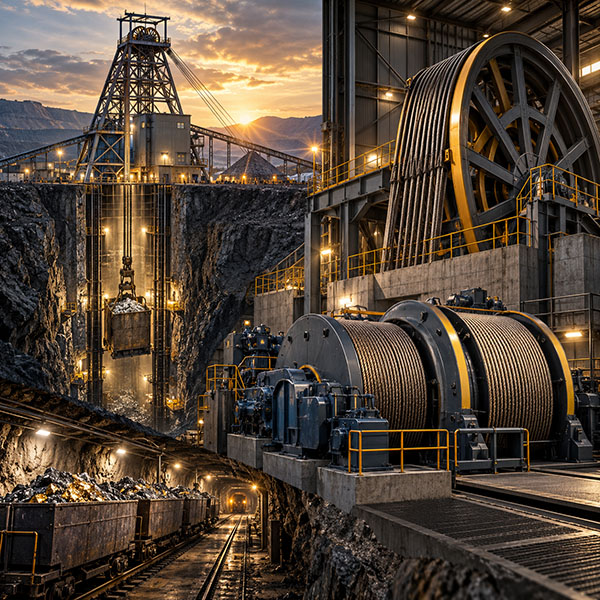
The Guide (Headframe & Sheaves): A tall steel structure and giant wheels that change the direction of the rope from horizontal (coming off the hoist drum) to vertical (going down the shaft).
The Muscle (Wire Rope): The unbreakable line connecting the surface to the depths.
The Cargo (Conveyance): The "elevator car" at the end of the rope.
For small to medium-sized mining operations—which make up the vast majority of our clients—the Ground-Mounted (or Floor-Mounted) Hoisting System is the gold standard. Why? Because the hoist is on solid ground. Maintenance crews don't need to climb precarious towers to service the motor. It’s cost-effective to build and, crucially, easier to operate.
The Key Components: The Skeleton and Muscles of the Shaft
To make informed purchasing decisions, you need to know what you're actually looking at when you visit a mine site. Let's demystify the jargon.
1. The Headframe (The Skeleton)
It's the iconic structure you see from miles away. But it's not just there for decoration. The headframe is the skeleton that supports the immense, dynamic loads of the hoisting operation. It must withstand the static tension of a kilometer-long rope hanging in the shaft plus the weight of a fully loaded skip of ore. A sturdy headframe isn't an expense; it's insurance against catastrophic alignment failure.
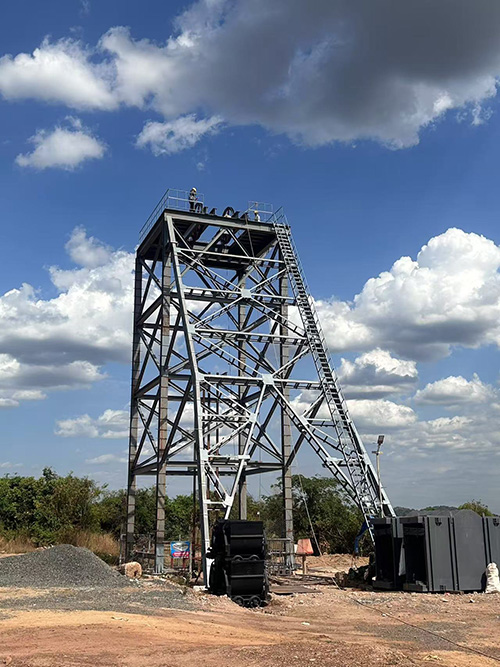
2. The Head Sheaves (The Direction Changers)
Perched atop the headframe are the massive wheels called sheaves. Their job is beautifully simple: Redirect Force. They take the horizontal pull from the ground-based hoist drum and convert it into a smooth, vertical lift. Without these, the rope would scrape the ground and snap within hours.
3. The Wire Rope (The Muscle Fibers)
Never call it a "cable." In mining, it's Wire Rope, and it's an engineering marvel. Unlike a simple chain, steel wire rope is designed with a specific twist and lay to handle Static Tension (the weight just hanging there) and Dynamic Tension (the shock of acceleration and deceleration). It is the single most critical safety component in the entire system.
4. The Conveyance: Skip vs. Cage (The Payload)
This is where the "elevator" analogy splits into two distinct jobs.
The Skip: This is the Dump Truck of the shaft. It's a container designed only for rock, ore, or waste. It loads at the bottom and automatically dumps its load into a surface bin at the top. You don't ride in a skip.
The Cage: This is the Passenger Elevator. It is reinforced, equipped with safety catches, and designed to transport miners, tools, and small vehicles. A safe cage means a safe crew.
The Core of the Operation: The Mine Hoist (The Heart)
Now we arrive at the most critical part of your capital expenditure: The Mine Hoist (Winder) . This is the only component that creates motion. Without a reliable hoist, the headframe is just a statue, and the shaft is just a deep, wet hole.
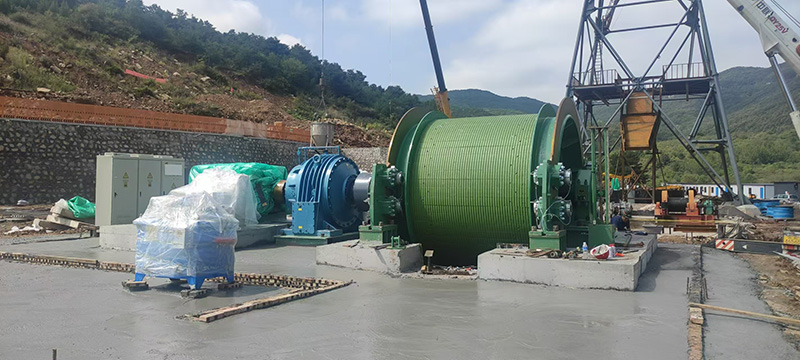
The Drum (Where the Muscle Winds)
The drum is the cylindrical spool that stores and winds the wire rope. This is where we see the biggest disconnect between "big mine thinking" and "smart business thinking."
For many mines in Africa, Asia, and Latin America, a massive 6-meter drum is not only unaffordable but also completely unnecessary. For shaft depths commonly found in these regions (200m to 600m), a Single Drum Hoist with a diameter between 1.0m and 1.6m is the workhorse of the industry. These compact units offer immense pulling power without the civil engineering costs required for larger foundations.
Power and Depth Capabilities
A common worry among new mine owners is: "Will a smaller hoist reach deep enough?"
The answer lies in Multi-Layer Winding. A modern, well-engineered compact hoist can wind rope in multiple layers on the drum. This means a hoist with a 1.2m or 1.6m diameter drum can comfortably manage shaft depths of 400 meters, 600 meters, and even approaching 800 meters depending on the rope diameter and payload. This makes them perfectly suited for the expansion phases of developing mines.
Why Choosing the Right Hoist Directly Impacts Your ROI
At the end of the quarter, the technical specifications matter less than the tonnage on the truck and the cost on the spreadsheet. Here is why Right-Sizing your hoist is a financial decision, not just an engineering one.
1. Operational Efficiency (Production Rate)
Time is ore. A hoist with jerky acceleration or frequent brake faults kills your cycle time. A smooth, robust hoist ensures that Skip is hitting the surface dump bin exactly when it's supposed to, maximizing your Production Rate per shift.
2. Safety (Your License to Operate)
This cannot be overstated. The Braking System on a mine hoist is non-negotiable. In the event of power loss or overspeed, the brakes must engage with calibrated, failsafe force. A hoist that is too small for the load will wear out brakes prematurely. A hoist that is too large might be overkill, but a hoist that is just right operates safely within its engineered duty cycle, protecting the lives of the men and women in the cage.
3. Cost-Effectiveness (The Goldilocks Zone)
Many traders push the biggest, most expensive unit they have in stock. We advise against that. An oversized hoist wastes electricity and requires a larger, more expensive headframe foundation. An undersized hoist is a liability that will require constant maintenance. The goal is Right-Sizing: matching the exact drum diameter and motor power to your specific shaft depth and payload.
Conclusion: The Foundation of Underground Success
A mine hoisting system is more than just hardware; it is the circulatory system of your underground operation. From the sturdy skeleton of the headframe to the precise power of the drum, every component must work in harmony.
If you are planning a new shaft, expanding an existing operation, or simply tired of downtime from unreliable equipment, you need a partner who speaks your language—both engineering and business.
Looking for stable, reliable hoisting equipment? Want to know exactly what drum size fits your shaft depth and budget? Contact our team today for a free consultation and a professional selection recommendation.
Sabrina He | Mining Machinery Specialist
With over 14 years of experience in the mining equipment industry, Sabrina He specializes in machinery selection, technical troubleshooting, and plant optimization.