Welcome to Changsha Mining Equipment Co., Ltd.
How Are Lithium Battery Locomotives Explosion-Proof? A Deep Dive into Mining Safety
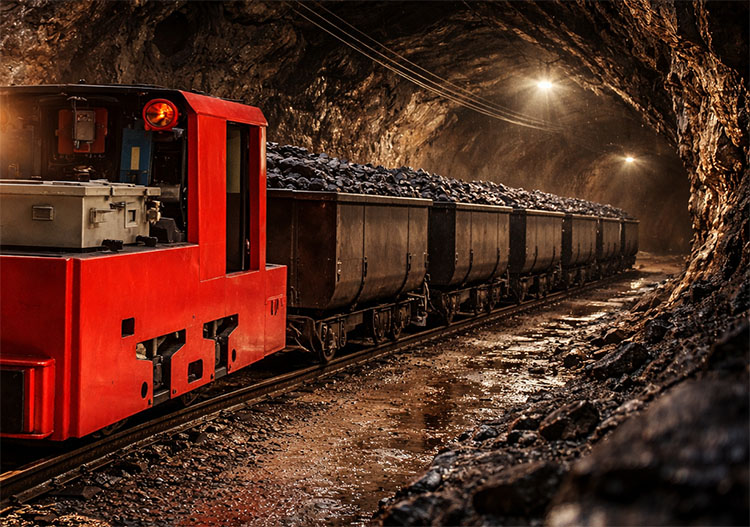
A recent test video circulating on mining industry social media has sparked intense discussion. The footage shows a robust, 5-ton explosion-proof lithium battery locomotive operating smoothly in a simulated underground tunnel, yet the comment section erupts with the same urgent question: "In an environment filled with methane gas and coal dust, how can a powerful lithium battery not cause a catastrophic explosion?" This is the paradox of modern underground haulage. We equip vehicles with high-density energy sources, then send them into volatile atmospheres where a single spark could be fatal.
The star of that video is not a conventional trolley or diesel machine. It’s a new generation of underground locomotive designed from the ground up for safety. The key to understanding this isn’t assuming the battery is chemically incapable of failure. Rather, the philosophy is profound engineering redundancy. If a fault occurs inside, the fire, pressure, and sparks are physically and electrically trapped, ensuring they never meet the outside atmosphere. This is the triple-layered safety shield of the flameproof locomotive.
What Does "Explosion-Proof" Mean in Underground Mining?
To appreciate the engineering, we must first understand the hazard. Underground coal mines are classified as hazardous locations because they can contain firedamp—primarily methane gas—and combustible coal dust. These substances, when mixed with air in the right concentration, become a volatile explosive cocktail waiting for an ignition source.
Therefore, "explosion-proof" in mining regulation (such as the stringent Coal Mine Safety Regulations) does not mean the equipment is immune to internal damage. It means isolation. The design logic is a fortress mentality: confine any potential explosion within the device housing, extinguish the escaping flames, and control the surface temperature so strictly that it stays well below the gas ignition point, even during a fault. Every electrical device on the locomotive must execute this principle flawlessly.
The Core Secret: Flameproof Enclosures (Ex d)
The most visible layer of protection is brute-force physical containment. Walking around the locomotive, you won't see exposed wiring, batteries, or motor terminals. Everything dangerous is sealed inside heavily engineered steel boxes. This is the Flameproof (Ex d) protection method, and it forms the backbone of the machine’s safety.
Our technical specifications reveal a detailed breakdown of these critical components:
Mine-use Flameproof Lithium-ion Battery Power Supply: The energy core is encased in a thick, precision-machined steel housing.
Flameproof Chopper Speed Controller: The brain of the speed regulation is similarly armoured.
Flameproof DC Traction Motor: Even the motive force is enclosed.
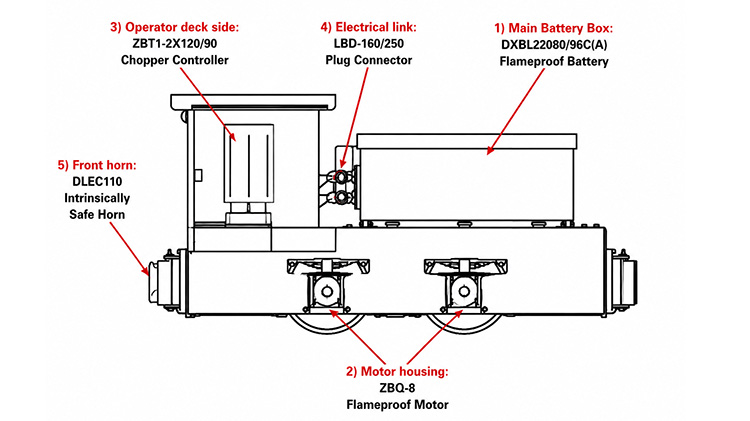
Here is how this life-saving technology works. If a short circuit or thermal event triggers an explosion inside the battery box, the massive steel walls are designed to withstand the internal pressure without rupturing. As the superheated gases and flames try to escape, they are forced through special flame paths (flameproof joints)—microscopically precise gaps between the housing lid and body. As the fire travels through this narrow labyrinth, its thermal energy is absorbed by the cool metal walls. By the time the gas reaches the outside atmosphere, it has been cooled well below the ignition temperature of methane. The explosion is choked inside.
Intrinsically Safe Systems: Preventing Sparks at the Source
While the main power train relies on heavy steel walls, a different philosophy protects the auxiliary circuits. High-power traction is one thing, but what about the horn or control signals? For these, we use Intrinsically Safe (Ex i) design. The principle is elegant: limit the electrical energy in a circuit so that it can never generate a spark hot enough to cause ignition, even in a worst-case scenario.
Take the electronic horn on our locomotive, for example. It is not just intrinsically safe; it is also built with Potting (Encapsulation) Technology. The delicate electronic circuit board is not exposed to air at all. Instead, it is completely submerged and sealed within a solid insulating resin compound. This physical exclusion guarantees that mine gases can never reach any potential weak point in the circuit. It’s a second, parallel safety net working alongside the main flameproof strategy.
Advanced Battery Management and Electrical Protection
An explosion-proof enclosure is the last line of defense; prevention is always the priority. This is handled by an intelligent Battery Management System (BMS) monitoring the lithium-ion cells in real-time.
Thermal runaway is the infamous phenomenon where a damaged battery cell enters an uncontrollable self-heating state. The BMS acts as a vigilant digital guard, continuously monitoring individual cell voltage, charge/discharge current, and temperature. If any parameter deviates from the safe window, the system instantly disconnects the pack, preventing the chain reaction that could lead to a fire or explosion.
Furthermore, our locomotive features a Chopper Speed Control system. Unlike older resistor-based controllers that burn excess electrical energy as waste heat (creating scorching surface temperatures and arcing risks), chopper control rapidly switches power on and off at a stable rated voltage of 96V DC. This provides smooth, stepless acceleration while dramatically reducing thermal stress and electrical arcing hazards, keeping the internal environment of the controller cool and stable.
Safe Mechanical Design
Safety extends beyond the electrical system into the fundamental mechanics. An explosion-proof locomotive must fail safely, meaning its stopping power cannot depend on the electronics in an emergency. Our 5-ton model relies on a purely mechanical braking system. When the operator turns the handwheel, force travels through a system of levers and rods to press the brake shoes firmly against the wheels. It’s a direct, physical, and infallible method that works even with total power loss.
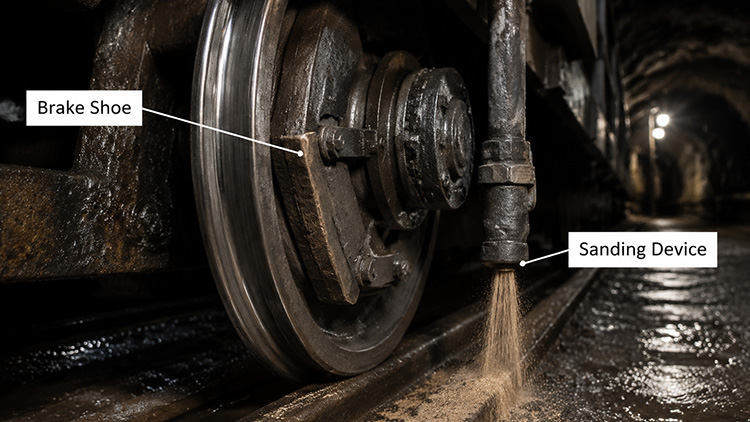
Additionally, the locomotive is equipped with a mechanical sanding device. Underground rails are often wet and slippery. Wheel slip generates friction heat, and in an extreme case, a spinning steel wheel against a rail could theoretically create a frictional spark. Our sanding system deposits a precise amount of dry sand onto the rail just ahead of the drive wheels, instantly increasing adhesion, eliminating slip, and removing any risk of frictional ignition.
Conclusion: Engineered for the Depths
The 5-ton explosion-proof lithium battery locomotive is not a single invention; it is an integrated safety ecosystem. The robust frame holds a power supply protected by armoured steel (Flameproof), controlled by a low-spark intelligent system (Chopper & BMS), supported by isolated auxiliary circuits (Intrinsic Safety & Potting), and stopped by purely physical mechanical brakes. This tri-layer defense—Hardened Enclosure, Smart Brain, and Pure Mechanics—ensures it meets the most rigorous mining safety standards on Earth.
Want to learn how our 5-ton or 9-ton explosion-proof locomotives can increase haulage efficiency while guaranteeing the highest safety margins in your mine? Click here to view full technical specifications or contact our engineering team today.
Sabrina He | Mining Machinery Specialist
With over 14 years of experience in the mining equipment industry, Sabrina He specializes in machinery selection, technical troubleshooting, and plant optimization.