Welcome to Changsha Mining Equipment Co., Ltd.
2026 Steel Rail Export Guide: Why the Real Delay Isn’t the License, But the COC Certificate
If you’ve been sourcing steel rails from China lately, you’ve probably heard about the new export license requirement that rolled out in 2026. There was some initial panic in the market—worries about red tape and stalled shipments. Frankly, we’ve found the reality on the ground to be much calmer. The Chinese Export License process is surprisingly fast now. In most cases, the paperwork clears within 2 to 3 working days, which means standard supply continuity isn’t the problem most buyers think it is.
(If you’re still getting your head around that new rule, we broke down the step-by-step application process in our previous guide—feel free to check that out.)
The real bottleneck, particularly for our clients in East Africa, isn’t getting rails out of China. It’s getting them into the destination country. If you’re shipping mining rails into Uganda, Tanzania, or Kenya, there’s a single piece of paper that can derail your entire project: the mandatory COC (Certificate of Conformity). And unlike the export license, this one can’t be rushed at the last minute.
What Exactly is a COC, and Why Do Governments Insist on It?
A COC, issued under the Pre-Export Verification of Conformity (PVoC) program, is essentially a safety net for the importing country. In Uganda, it’s mandated by UNBS, and in Tanzania, by TBS. Their logic is straightforward: they want to stop substandard steel from creeping into critical mining and railway infrastructure. Nobody wants a rail buckling under a heavy locomotive six months after installation.
But beyond the obvious safety aspect, there’s a hard financial reason this certificate matters to buyers. Without a valid COC, customs in Dar es Salaam or Mombasa can hit you with a penalty that stings—we’ve seen charges go as high as 15% of the CIF value. Worse, they can simply reject the cargo. A few containers of heavy steel rails sitting in port, accumulating demurrage fees by the day, can wipe out your project’s margin very quickly. On the flip side, a properly issued COC fast-tracks your customs clearance, so you aren’t bleeding money on storage while waiting for clearance.
How the Inspection Really Works (It’s Not Just Paperwork)
We’ve handled enough of these shipments to know that getting a COC isn’t just an admin exercise. It’s a physical, on-the-ground operation. The process usually unfolds in four phases, and skipping even a small detail can cause chaos.
Phase 1: The Document Audit
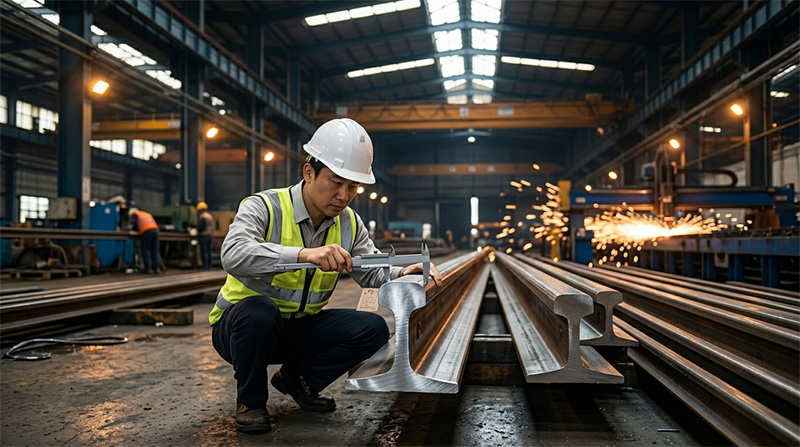
Before a single rail is loaded, the surveying company wants to see the hard data. We pull together the original Mill Test Certificates (MTCs), the detailed packing list, and any third-party lab reports showing the chemical and physical properties of the steel. If the grades don’t match the original proforma invoice, the application gets stalled right here.
Phase 2: The Three-Way Synchronization
This is where pure trading companies often trip up. You need perfect alignment between our logistics team, the steel mill’s loading crew, and the freight forwarder at the port. You can’t book an inspector unless the container is there, and you can’t have the container sitting idle for three days while you wait for the surveyor. We usually anchor this process ourselves, sending a dedicated rep to ensure the factory and the forwarder are on the same timeline.
Phase 3: The Inspection Itself
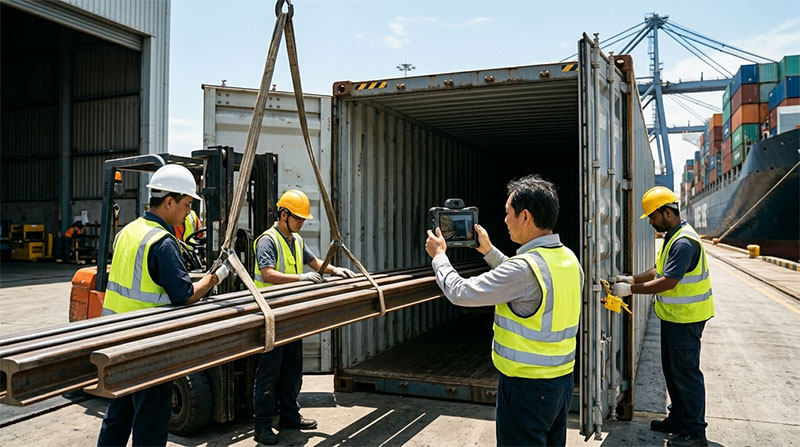
The surveyor doesn’t just glance at the rails. They’re measuring dimensions, checking surface quality, and verifying markings against the MTC. Then comes what we jokingly call the “photo frenzy.” There’s a strict checklist: a picture of the totally empty container, one at the half-loaded stage, one showing the fully loaded cargo with the doors open, and finally, a clear close-up of the sealed container number. Miss the empty-container photo, and the whole COC can be rejected.
Phase 4: Final Issuance
After the vessel sails, we file the final Bill of Lading (BL) with the inspection body, which then releases the original COC. We usually courier the hard copy alongside the other shipping documents to ensure it arrives before the cargo does.
It’s Not Just East Africa
While we’ve been focused on Uganda and Tanzania lately, this isn’t just an East African headache. Pre-shipment conformity is becoming the standard globally. If you’re moving heavy mining steel into Kenya, you’re dealing with their own PVoC framework. For Nigeria, it’s the SONCAP certificate. Saudi Arabia has the SABER platform, and Egypt requires the GOEIC registration. The landscape is getting more fragmented, and assuming the rules are the same everywhere is a risky bet. Having a trading partner who understands the specific inspector preferences across these regions saves you from learning expensive lessons the hard way.
How We Keep Your Supply Chain Clean
The main reason COCs get delayed isn’t because the steel is bad; it’s because communication breaks down. A pure broker who never touches the product often can’t manage the gritty friction between a busy factory and a strict port forwarder. Cargo gets “left behind” on the paperwork simply because a seal number photo was blurry or an inspector wasn’t notified in time.
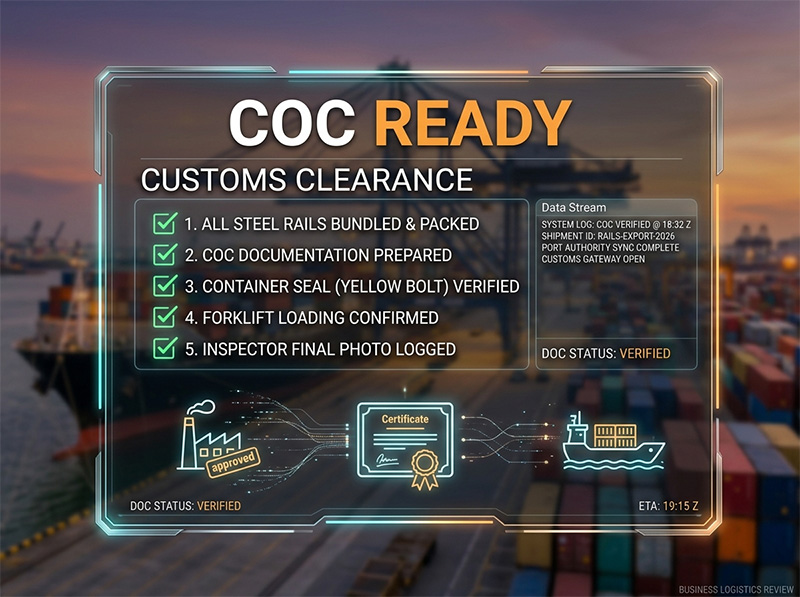
Because we’re specialized in mining equipment, we’ve embedded this compliance photography and inspection scheduling directly into our standard loading process. It’s not an add-on service; it’s part of the pipeline. We treat the empty container photo and the seal number verification with the same urgency as the rail quality itself. Our promise is simple: if we handle the shipment, there are no compliance surprises at the destination port.
Ready to Move Forward Without the Headaches?
Navigating the 2026 compliance maze—from China’s export desk to East Africa’s port gates—can feel complex, but it doesn’t have to be your headache. If you’re planning a mining or railway project in Africa or the Middle East, reach out to our team. We’ll help you map out the compliance route and give you a transparent quote, so you can focus on the project itself, not the paperwork.
Aizen Liu | Delivery Manager
I oversees our international supply chain, ensuring that heavy-duty mining equipment reaches your site safely and on schedule. From complex customs clearance to final delivery, I provides a seamless and hassle-free procurement experience for our global clients.