Welcome to Changsha Mining Equipment Co., Ltd.
Surface vs. Underground Mining: Does Your Project Need a Wheel Loader or an LHD?
It’s a scenario that plays out far too often in the copper belts of Zambia or the narrow gold veins of Colombia: a mine owner purchases a "good deal" on a loading machine, only to find the cabin roof crushed against a tunnel ceiling or the tires spinning uselessly in the surface pit's rainy season mud. In the world of mining equipment selection, a machine’s effectiveness isn't just about bucket capacity—it’s about the marriage between machine geometry and the mine's geology.
For SME mining Africa South America operators, this decision is binary: you either need the high-clearance, long-reach agility of a 5-ton wheel loader, or the low-slung, dense-rock power of a 3 cubic meter LHD. Choosing incorrectly doesn't just slow production; it destroys your cost-per-ton economics.
Let’s break down the engineering realities behind these two workhorses to help you make a fleet decision that maximizes uptime and safety.
Understanding the Surface Champion: The 5-Ton Wheel Loader
In open-pit mines, quarries, and surface stockpiles, terrain is the enemy. Whether it's the torrential downpours in West Africa turning haul roads into swamps or the dusty, uneven hard-pack of the Atacama, a surface loader must be built like an all-terrain truck.
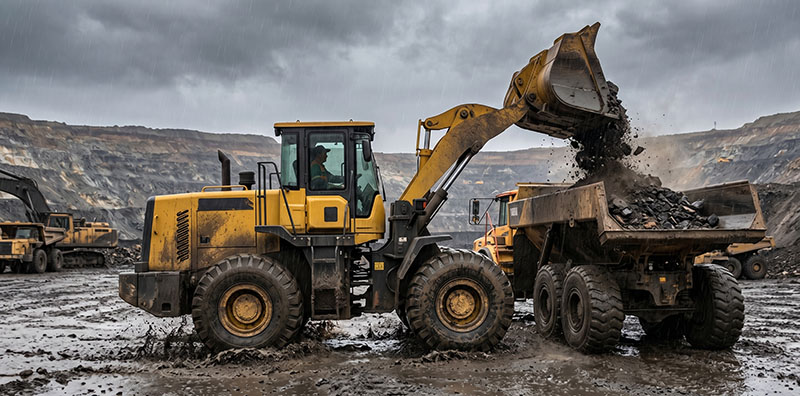
Best Application: Open-pit mining, aggregate handling, and loading articulated dump trucks (ADTs) on rough terrain.
Key Specifications That Drive Surface Profitability:
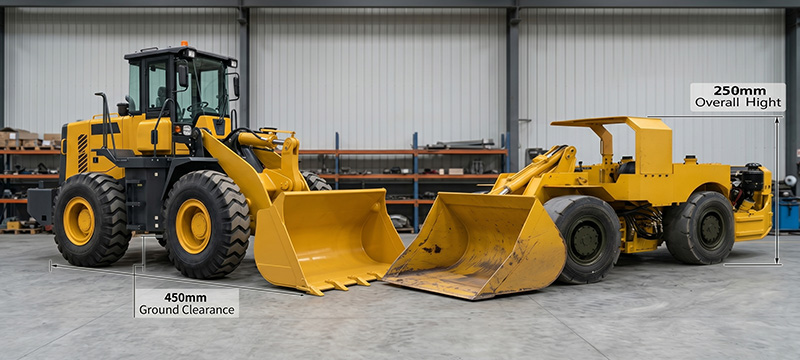
High Ground Clearance (450mm): In surface mining, clearance is king. A 450mm underbelly clearance isn't just a number on a spec sheet; it's the difference between a full shift of production and a six-hour recovery mission when the rains hit. In the soft, rutted roads of remote South American or African sites, a lower machine will "belly out"—its chassis dragging on the center ridge of the road. The 5-ton loader’s high profile ensures you keep moving material regardless of the weather.
Maximum Dump Height (3200mm): Surface mining relies on "pass matching." If your loader can't clear the side rail of a standard 40-ton articulated hauler or a highway tipper truck, you spill material, damage the truck bed, and create a safety hazard. A 3,200mm dump height provides the necessary clearance to load over tall truck sides cleanly and efficiently, ensuring every bucket of ore makes it to the crusher, not the ground.
Power and Tractive Force (162kW Weichai Engine & 148KN): For mining operators in remote areas, mechanical simplicity is as valuable as diesel power. The Weichai engine package featured in this class is widely recognized across Africa and South America for being "wrench-friendly." It doesn't require a clean-room laptop or a specialist engineer with proprietary software. With 148KN of tractive force, this loader digs into muck piles with authority and climbs surface ramps with 30° gradeability, even when fully loaded with dense, wet material.
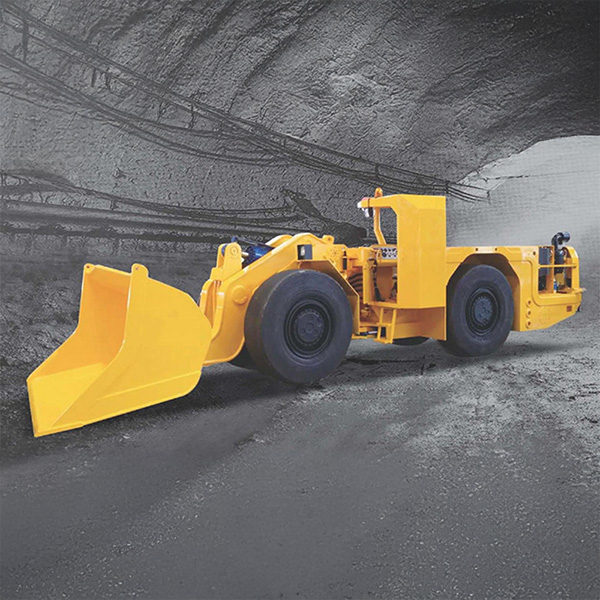
The Underground Specialist: The WJ-3A LHD (Load-Haul-Dump)
Step away from the open sky and into the confined world of a development drift or a drawpoint. The physics change entirely. Here, a Wheel Loader vs LHD comparison becomes a matter of survival. A machine that is tall, wide, and articulated for turning radius is a liability underground.
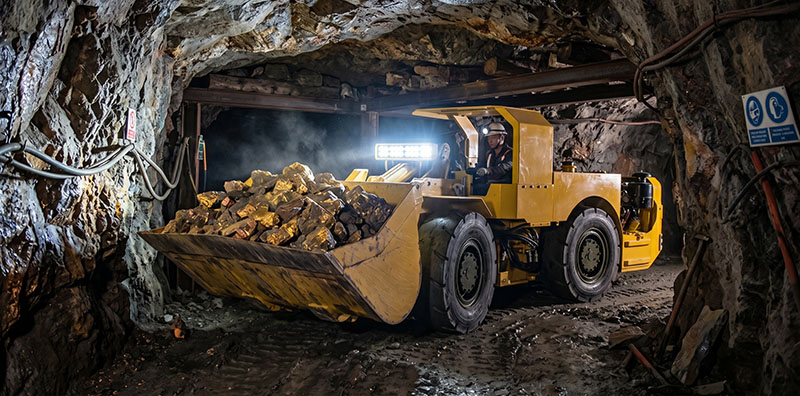
Best Application: Narrow-vein mining, tunnel development, and loading low-profile underground trucks.
Key Specifications That Define Underground Efficiency:
Low Profile & Compact Dimensions (H: 2250mm, W: 2130mm): Compare this directly to the surface loader's height of 3,470mm. That’s over a meter of difference. In an underground adit with a back (roof) of just 2.8 meters, the surface loader is a wreck waiting to happen. The WJ-3A LHD is purpose-built to slither through tight tunnels. Its 2,130mm width allows it to navigate narrow vein stopes where space is a premium cost. This is not an optional feature; it is the machine's primary reason for existence.
High-Density Payload (6.0T Rated Load in 3.0m³ Bucket): Here’s a critical engineering nuance that many buyers miss. The surface loader uses a 3.0m³ bucket for 5 tons of lighter aggregate. The LHD uses a 3.0m³ bucket for 6 tons. Why? Underground ore (especially gold, copper, and lead-zinc) is blasted into heavy, jagged chunks. The LHD chassis, axles, and articulation joint are reinforced to handle this denser, more abrasive material. If you use a surface loader to move 6-ton bites of heavy ore, you will shear the center pins and destroy the driveline.
Maneuverability (Inner Turning Radius 2934mm): Underground mining is a series of 90-degree turns at crosscuts and drawpoints. The tight 2,934mm inner turning radius of the WJ-3A allows the operator to load a pile, reverse, and make the corner in one smooth motion. This agility is non-negotiable for maintaining ventilation flow and cycle times in a tunnel environment.
Low Dump Height (2300mm): Note the difference: Surface loader dumps high (3.2m) for trucks; the LHD dumps low (2.3m) for underground mining equipment like low-profile mine trucks or directly into the grizzly of an ore pass. It is a symbiotic system.
Head-to-Head: Matching the Machine to Your Mine Plan
As a fleet manager for an SME operation, your decision comes down to two specific operational profiles. Let's look at the most common scenarios we see in Africa and South America:
Scenario A: The Hybrid or "Trench" Mine
You have a narrow, high-grade vein that is accessed from surface via a shallow trench or a small adit. You might be tempted to save money by using a single surface wheel loader for everything. Avoid this. Even if the grade is 30°, the width of a surface loader is too wide for the trench, and the height will result in a collision with the wall or roof. For this operation, the WJ-3A LHD is the only safe and productive choice. Its 6.0T density handling allows you to extract heavy ore from the face and tram it efficiently to the surface stockpile.
Scenario B: The Expanding Open Pit (Rainy Season Operations)
Your mine is a growing pit with no tunnel access. You need to move large volumes of overburden and ore into standard wide-body trucks across terrain that turns to soup when it rains. The decision is clear: you need the 5-Ton Wheel Loader. The 450mm ground clearance and 3,200mm dump height are essential for keeping your haul trucks moving and your machine out of the mud.
Maintenance & TCO (Total Cost of Ownership)
A final, critical factor for SME mining Africa South America is support. Both the surface loader (Weichai) and the LHD (Yuchai) utilize power units known for robust parts availability in the developing world. You won't be grounded for six weeks waiting for a proprietary sensor to clear customs. This keeps your Total Cost of Ownership (TCO) low and your production high.
Conclusion: Precision Over Guesswork
Ultimately, the choice between underground mining equipment and surface loaders is not about which machine is "better"—it is about which machine is right. It is a decision defined by tunnel height versus dump height, and payload density versus terrain clearance.
Equipment mismatch is the silent killer of mining margins. Whether you're in the Andes or the African Copperbelt, fitting the tool to the task ensures safety, uptime, and a better cost-per-ton.
Still unsure which machine will deliver the best return for your specific site layout? Don't gamble on a generic solution. Contact our engineering team today. Send us your mine's drift dimensions, your target production per shift, and a photo of your loading area. We’ll provide a free, no-obligation fleet-matching consultation to ensure you commission the exact machinery required for your project's success.
Sabrina He | Mining Machinery Specialist
With over 14 years of experience in the mining equipment industry, Sabrina He specializes in machinery selection, technical troubleshooting, and plant optimization.