Welcome to Changsha Mining Equipment Co., Ltd.
Dispatch Winch vs. Scraper Winch: Which One Do You Need for Your Mining Project?
In the demanding environment of underground mining, efficient material handling is the backbone of productivity and safety. Every minute counts, and choosing the wrong equipment can create a bottleneck that slows down your entire operation. A common point of confusion for many procurement managers and project engineers is distinguishing between the Dispatch Winch and the Scraper Winch.
While both are essential for moving material, they serve fundamentally different purposes. Selecting the wrong type can lead to inefficiencies, increased wear and tear, or even safety hazards. To help you make an informed purchasing decision, this article breaks down the core differences, key specifications, and ideal applications for each machine.
What is a Dispatch Winch?
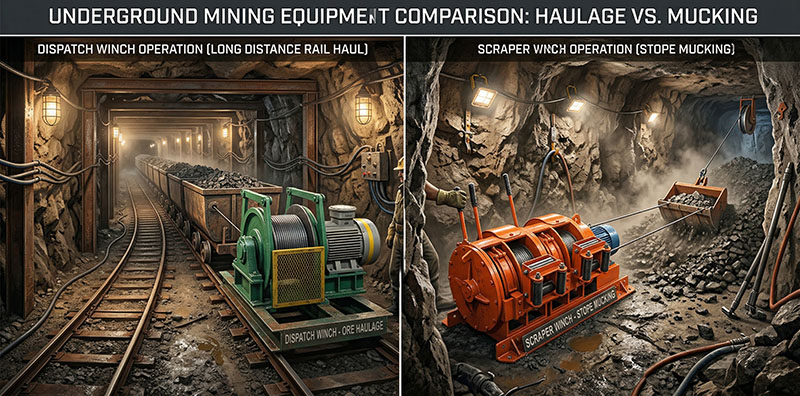
Often referred to as a “towing machine” in mining slang, the Dispatch Winch is designed primarily for rail haulage. Its primary job is to move heavy mine cars (skips or flatcars) along horizontal or inclined underground tracks.
Structurally, the Dispatch Winch features a single-drum design. This focus allows it to generate a powerful, unidirectional pull over long distances.
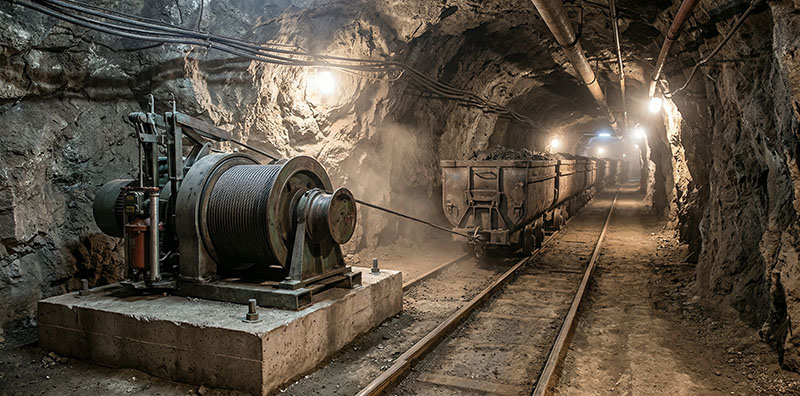
When selecting a Dispatch Winch (such as the JD series), there are two critical specifications to consider:
Rope Capacity: Dispatch winches are built for long-distance towing. For example, the JD-4 model offers a substantial rope capacity of 650 meters, ideal for long drifts.
Maximum Static Tension: This determines how much weight you can pull. Depending on the model—from the JD-1 (10 kN) to the JD-4 (40 kN)—you can match the pulling force to the size and weight of your loaded mine cars.
What is a Scraper Winch?
Unlike the Dispatch Winch, the Scraper Winch is used for bulk material handling. It works in tandem with a scraper bucket to collect and drag loose ore from the blast face (stope) to a loading point or ore pass.
This equipment is distinguished by its double-drum (or triple-drum) design. The engineering here is cyclical: the “working drum” pulls the loaded bucket toward the winch with high tension, while the “empty drum” quickly pulls the empty bucket back out to repeat the cycle.
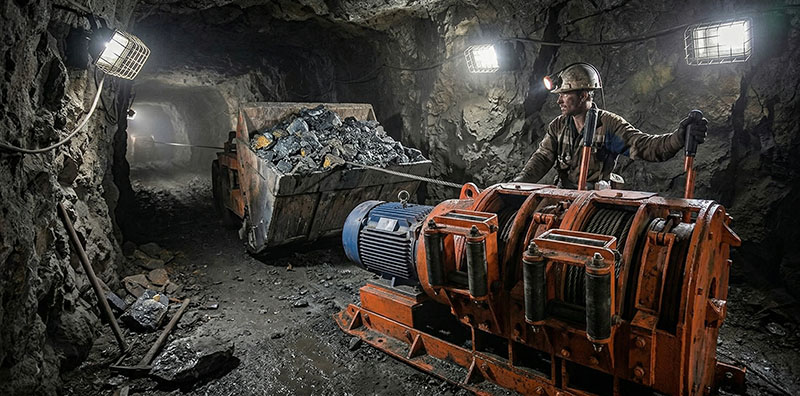
Key specifications for the Scraper Winch (2JP Series) include:
Scraper Bucket Volume: This defines your material handling efficiency. Models range from small units handling 0.1 m³ buckets (2JP-7.5) up to high-capacity units handling 1.4 m³ buckets (2JP-90/110).
Pulling Force & Speed: Notice the dual nature of the specs. For instance, the 2JP-55 model delivers 50 kN of force on the working drum but only 33.5 kN on the empty drum, while running the empty rope significantly faster (1.8 m/s) than the working rope (1.2 m/s). This design maximizes cycle times.
Head-to-Head Comparison: Key Differences
To help you visualize the differences, here is a quick breakdown:
Primary Function:
Dispatch Winch: Track towing (pulling mine cars on rails).
Scraper Winch: Bulk material scraping (pulling loose ore with a bucket).
Operational Distance:
Dispatch Winch: Long-distance transport (rope capacities from 400m to 650m).
Scraper Winch: Short-distance, reciprocating motion (rope capacities typically 45m to 210m, designed for localized stopes).
Essential Attachments:
Dispatch Winch: Utilizes mine cars, hooks, and rail couplers.
Scraper Winch: Utilizes scraper buckets, pulleys, and tail sheaves.
How to Choose the Right Winch?
The decision comes down to your specific application. Ask yourself: Where is the material moving from, and where is it going?
Choose a Dispatch Winch (JD Series) if:
You need to transport material linearly. If your operation requires moving a train of ore cars from a loading chute to the shaft or surface along a track, the Dispatch Winch is your solution. It is optimized for consistent tension over long distances. When inquiring about this model, be prepared to specify your required tension (kN) and the length of your haulage way to ensure adequate rope capacity.
Choose a Scraper Winch (2JP Series) if:
You are working in a stope or drawpoint. If you need to gather blasted, loose muck from the floor and drag it into a crusher or ore pass, the Scraper Winch is the industry standard. For these units, focus on your desired efficiency. Let the manufacturer know your required bucket volume (e.g., 0.4 m³ or 1.0 m³) so they can recommend the correct motor power and pulling force.
Conclusion & Call to Action
Selecting the correct winch is not just about moving material; it’s about optimizing your workflow, reducing operational downtime, and ensuring the safety of your crew. By matching the winch type—Dispatch for rail haulage or Scraper for loose muck handling—to your specific project requirements, you set the stage for a more productive mine site.
Still unsure which model fits your underground mine? Making the wrong choice can be costly.
Contact our engineering team today for a free consultation and quote! We’ll help you analyze your site conditions and recommend the perfect winch for your project.
With over 14 years of experience in the mining equipment industry, Sabrina He specializes in machinery selection, technical troubleshooting, and plant optimization.