Welcome to Changsha Mining Equipment Co., Ltd.
Avoid Costly Mistakes: The Ultimate Guide to Pairing Mucking Loaders with Mining Tricycles
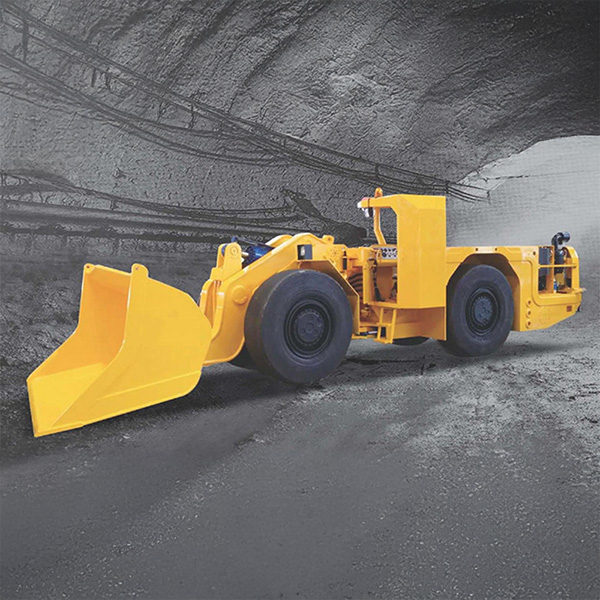
In the confined, high-stakes environment of underground mining, your profitability hinges on one thing: efficiency. The mucking loader and the mining tricycle form the backbone of your mucking cycle—a true "golden partnership." The loader digs and conveys, while the tricycle hauls away the waste.
However, many mines fall into the trap of sourcing these machines separately. They arrive on site, only to fail spectacularly. The loader’s conveyor misses the tricycle box, or a fully loaded tricycle gets stuck on a slope. This downtime is incredibly costly. This guide uses specific technical parameters to show you exactly how to match these two workhorses for seamless integration.
The Core Match: Height and Distance
This is the most visible aspect of compatibility. If these dimensions are off, loading becomes impossible.
1. Discharge Height vs. Loading Height
The Principle: The mucking loader’s discharge height must be greater than the tricycle’s loading height. You should always leave a safety margin of 100mm to 200mm. This prevents the loader from crashing into the tricycle and accommodates larger rocks.
The Data: Looking at the D10, D20, and D30 tricycles, their loading heights range from 1200mm to 1250mm.
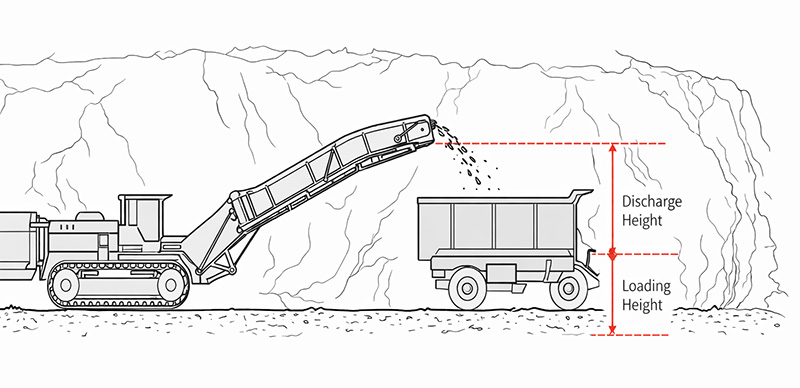
The Risk: If you choose a base-model ZWY-50 (Discharge Height: 1200mm), the heights are flush. This leaves zero room for error and risks constant collision.
The Solution: All ZWY models feature a discharge height that "(can be raised)." If you plan to use a larger D30 tricycle (1250mm loading height), you must request that the manufacturer raise the ZWY-50 or ZWY-60 conveyor to at least 1400mm.
2. Dumping Distance vs. Container Length
The Principle: The dumping distance determines where the material lands in the tray. If the reach is too short, material piles up at the rear. This prevents you from filling the box fully and causes dangerous instability (tipping).
The Data: A D30 tricycle has an outer container length of 2200mm. A ZWY-50 has a dumping distance of only 1300mm.
The Risk: The loader can only reach the rear half of the box, leading to underloading and poor weight distribution.
The Solution: Choose a loader with an "(extendable)" conveyor. For longer tricycles, ensure the dumping distance is at least 1600mm (like the ZWY-70), or coordinate with the driver to move the tricycle forward and backward during loading.
Hidden Dangers: 3 Critical Parameters You Must Check
Beyond height and distance, the data sheets hide three "landmines" that can halt your entire operation.
1. The Gradeability Mismatch (Safety Hazard)
Deep Dive: Look closely at the specs. The ZWY series loaders can handle a 15° grade on a hard surface. However, the D-series tricycles, when fully loaded, have a maximum gradeability of only 6°
The Advice: You must design your mine roadways around the tricycle’s 6° limit. If your tunnel slope is 10°, the loader can descend easily, but the tricycle, loaded with tons of rock, will not be able to climb out. This creates a serious risk of stalling or even runaway vehicles.
2. Roadway Space and Turning Radius
Deep Dive: The tunnel must accommodate not just the loader working, but also the tricycle maneuvering around it. A ZWY-120 requires a minimum roadway section of 3m x 3m. Meanwhile, a D30 tricycle has a massive turning radius of 4900mm.
The Advice: In dead-end drifts, a large tricycle may struggle to position itself under the loader or turn around to exit. Ensure your tunnel width is generous enough to allow the tricycle to pass the parked loader and maneuver into place.
3. Efficiency and Fleet Matching
Deep Dive: A high-capacity loader needs enough trucks to feed. A ZWY-80 can load up to 80 m³ per hour, while a D20 tricycle holds only 1.1 m³.
The Advice: If a D20 takes less than one minute to fill, but the haul distance is long, one loader will spend most of its time "waiting for trucks." To achieve maximum efficiency, a single high-capacity loader typically requires a fleet of 3 to 5 tricycles rotating in a continuous loop.
Conclusion
Matching a mucking loader and a tricycle is not about buying the biggest models available. It is a system engineering challenge involving height, reach, slope, and space.
Still unsure which ZWY model perfectly fits your D-series fleet? Send us your tunnel dimensions and daily production targets. Our engineers will provide a free, 1-on-1 equipment matching solution to maximize your mine's output.